Sunday, November 20, 2016

Pope: Full text of homily for Solemnity of Christ the King


The statue of Christ atop the facade of St Peter's Basilica. On Sunday, Pope Francis celebrated the Sacred Liturgy for the Solemnity of Jesus Christ, King of the Universe, in the Piazza in front of the Basilica. - AP


20/11/2016 10:30

Homily of His Holiness Pope Francis
Solemnity of Our Lord Jesus Christ, King of the Universe
20 November 2016

The Solemnity of Our Lord Jesus Christ, King of the Universe, is the crown of the liturgical year and this Holy Year of Mercy.  The Gospel in fact presents the kingship of Jesus as the culmination of his saving work, and it does so in a surprising way.  “The Christ of God, the Chosen One, the King” (Lk 23:35,37) appears without power or glory: he is on the cross, where he seems more to be conquered than conqueror.  His kingship is paradoxical: his throne is the cross; his crown is made of thorns; he has no sceptre, but a reed is put into his hand; he does not have luxurious clothing, but is stripped of his tunic; he wears no shiny rings on his fingers, but his hands are pierced with nails; he has no treasure, but is sold for thirty pieces of silver.
Jesus’ reign is truly not of this world (cf. Jn 18:36); but for this reason, Saint Paul tells us in the Second Reading, we find redemption and forgiveness (cf. Col 1:13-14).  For the grandeur of his kingdom is not power as defined by this world, but the love of God, a love capable of encountering and healing all things.  Christ lowered himself to us out of this love, he lived our human misery, he suffered the lowest point of our human condition: injustice, betrayal, abandonment; he experienced death, the tomb, hell.  And so our King went to the ends of the universe in order to embrace and save every living being.  He did not condemn us, nor did he conquer us, and he never disregarded our freedom, but he paved the way with a humble love that forgives all things, hopes all things, sustains all things (cf. 1 Cor 13:7).  This love alone overcame and continues to overcome our worst enemies: sin, death, fear.
Dear brothers and sisters, today we proclaim this singular victory, by which Jesus became the King of every age, the Lord of history: with the sole power of love, which is the nature of God, his very life, and which has no end (cf. 1 Cor 13:8).  We joyfully share the splendour of having Jesus as our King: his rule of love transforms sin into grace, death into resurrection, fear into trust.
It would mean very little, however, if we believed Jesus was King of the universe, but did not make him Lord of our lives: all this is empty if we do not personally accept Jesus and if we do not also accept his way of being King.  The people presented to us in today’s Gospel, however, help us.  In addition to Jesus, three figures appear: the people who are looking on, those near the cross, and the criminal crucified next to Jesus.
First, the people: the Gospel says that “the people stood by, watching” (Lk 23:35): no one says a word, no one draws any closer.  The people keep their distance, just to see what is happening.  They are the same people who were pressing in on Jesus when they needed something, and who now keep their distance.  Given the circumstances of our lives and our unfulfilled expectations, we too can be tempted to keep our distance from Jesus’ kingship, to not accept completely the scandal of his humble love, which unsettles and disturbs us.  We prefer to remain at the window, to stand apart, rather than draw near and be with him.  A people who are holy, however, who have Jesus as their King, are called to follow his way of tangible love; they are called to ask themselves, each one each day: “What does love ask of me, where is it urging me to go?  What answer am I giving Jesus with my life?”
There is a second group, which includes various individuals: the leaders of the people, the soldiers and a criminal.  They all mock Jesus.  They provoke him in the same way: “Save yourself!” (Lk 23:35,37,39).  This temptation is worse than that of the people.  They tempt Jesus, just as the devil did at the beginning of the Gospel (cf. Lk 4:1-13), to give up reigning as God wills, and instead to reign according to the world’s ways: to come down from the cross and destroy his enemies!  If he is God, let him show his power and superiority!  This temptation is a direct attack on love: “save yourself” (vv. 37,39); not others, but yourself.  Claim triumph for yourself with your power, with your glory, with your victory.  It is the most terrible temptation, the first and the last of the Gospel.  When confronted with this attack on his very way of being, Jesus does not speak, he does not react.  He does not defend himself, he does not try to convince them, he does not mount a defence of his kingship.  He continues rather to love; he forgives, he lives this moment of trial according to the Father’s will, certain that love will bear fruit.
In order to receive the kingship of Jesus, we are called to struggle against this temptation, called to fix our gaze on the Crucified One, to become ever more faithful to him.  How many times, even among ourselves, do we seek out the comforts and certainties offered by the world.  How many times are we tempted to come down from the Cross.  The lure of power and success seem an easy, quick way to spread the Gospel; we soon forget how the Kingdom of God works.  This Year of Mercy invites us to rediscover the core, to return to what is essential.  This time of mercy calls us to look to the true face of our King, the one that shines out at Easter, and to rediscover the youthful, beautiful face of the Church, the face that is radiant when it is welcoming, free, faithful, poor in means but rich in love, on mission.  Mercy, which takes us to the heart of the Gospel, urges us to give up habits and practices which may be obstacles to serving the Kingdom of God; mercy urges us to orient ourselves only in the perennial and humble kingship of Jesus, not in submission to the precarious regalities and changing powers of every age.
In the Gospel another person appears, closer to Jesus, the thief who begs him: “Jesus, remember me when you come into your kingdom” (v. 42).  This person, simply looking at Jesus, believed in his kingdom.  He was not closed in on himself, but rather – with his errors, his sins and his troubles – he turned to Jesus.  He asked to be remembered, and he experienced God’s mercy: “Today you will be with me in paradise” (v. 43).  As soon as we give God the chance, he remembers us.  He is ready to completely and forever cancel our sin, because his memory – unlike our own – does not record evil that has been done or keep score of injustices experienced.  God has no memory of sin, but only of us, of each of us, we who are his beloved children.  And he believes that it is always possible to start anew, to raise ourselves up.
Let us also ask for the gift of this open and living memory.  Let us ask for the grace of never closing the doors of reconciliation and pardon, but rather of knowing how to go beyond evil and differences, opening every possible pathway of hope.  As God believes in us, infinitely beyond any merits we have, so too we are called to instil hope and provide opportunities to others.  Because even if the Holy Door closes, the true door of mercy which is the heart of Christ always remains open wide for us.  From the lacerated side of the Risen One until the very end of time flow mercy, consolation and hope.
So many pilgrims have crossed the threshold of the Holy Doors, and far away from the clamour of the daily news they have tasted the great goodness of the Lord.  We give thanks for this, as we recall how we have received mercy in order to be merciful, in order that we too may become instruments of mercy.  Let us go forward on this road together.  May our Blessed Lady accompany us, she who was also close to the Cross, she who gave birth to us there as the tender Mother of the Church, who desires to gather all under her mantle.  Beneath the Cross, she saw the good thief receive pardon, and she took Jesus’ disciple as her son.  She is Mother of Mercy, to whom we entrust ourselves: every situation we are in, every prayer we make, when lifted up to his merciful eyes, will find an answer.

....
Taken from: http://en.radiovaticana.va/news/2016/11/20/pope_full_text_of_homily_for_solemnity_of_christ_the_king/1273568

Friday, November 18, 2016

Pope Francis dismisses critics of his teachings


 | 


Vatican City -- Pope Francis is firing back at foes of his efforts to make the Catholic church more open and pastoral in its ministry, telling an interviewer that “they are acting in bad faith to foment divisions.”
The pontiff’s lengthy interview in Avvenire, the official newspaper of the Italian hierarchy, was published Friday and followed days of news coverage of demands by four hard-line cardinals who have grave concerns about Francis’ approach.
The four say that focusing on ministering to people in their particular circumstances is eroding the church’s doctrinal absolutes and that Francis must dispel any ambiguities or face serious consequences.
The four critics, led by U.S. Cardinal Raymond Burke, a Rome-based prelate and longtime opponent of the pontiff’s policies, had written privately to Francis in September.
They asked the pontiff to state whether passages in a landmark document on ministering to families that he had issued in April could be interpreted to allow divorced and remarried Catholics to receive Communion in some cases.
Joy-of-the-Family-Guide.jpgExplore Pope Francis’ apostolic exhortation on the family. Download our free study guide.
On Monday, the cardinals went public with the letter because they learned that Francis was not going to respond to their demands that he answer five specific questions about the document, an exhortation called Amoris Laetitia, or “The Joy of Love."
The cardinals said he had to answer their questions in order to clear up their doubts about whether the document undermined the church’s teaching on sin and the permanence of marriage.
Then in an interview published Tuesday in the National Catholic Register, Burke raised the stakes by saying that if Francis did not offer a clarification, the next step would be to make “a formal act of correction of a serious error" — a phrase that some believe is tantamount to accusing the pope of heresy.
Avvenire’s interview with Francis focused largely on ecumenism and Catholicism’s relations with other churches.
But the pope also took the opportunity to push back against his critics — he did not name them — who view the faith through the lens of “a certain legalism, which can be ideological."
“Some people — I am thinking of certain responses to Amoris Laetitia — continue to misunderstand," Francis said. “It’s either black or white [to them], even if in the flow of life you have to discern."
Asked about critics who accuse the pope of “Protestantizing" the Catholic church — an objection often raised by conservative Catholics in the U.S. — Francis said, “I don’t lose sleep over it."
He insisted that he is following the model of the Second Vatican Council of the 1960s that set the church on a path to internal reform and greater engagement with the world.
“As for opinions of others," he said, “we always have to distinguish the spirit in which they are given. When not given in bad faith, they help with the way forward. Other times you see right away that the critics pick bits from here and there to justify a pre-existing viewpoint; they are not honest, they are acting in bad faith to foment divisions."
“You see right away that a certain ‘rigorism’ is born out of a lack of something, from a desire to hide inside the armor of one’s own sad dissatisfaction," he said.
The papal document Amoris Laetitia was Francis’ summation of two extraordinary Vatican meetings of the world’s bishops, held in 2014 and 2015, that sought to reorient the church’s approach away from a focus on doctrinal formulations and the reiteration of rules and toward accompanying people in difficult or unusual circumstances.
But the document has become a flashpoint for an increasingly open struggle between old guard hard-liners and supporters of Francis.
One of the three American prelates that Francis is to elevate to the rank of cardinal on Saturday — along with 14 other churchmen — pushed back against Burke’s campaign in unusually strong language, calling the effort “troublesome."
Cardinal-designate Joseph Tobin, who is going to head the Archdiocese of Newark, told The Tablet of London that Amoris Laetitia cannot simply be reduced to a question of ‘yes or no’ in a specific pastoral situation."
He said that the challenge by the four cardinals “is at best naive."
Related stories:
....
Taken from: https://www.ncronline.org/news/vatican/pope-francis-dismisses-critics-his-teachings

Saturday, November 12, 2016

Pope Francis: the Church's mercy is for everyone


By Hannah Brockhaus


.- Pope Francis spoke to pilgrims about how the mercy of God is for everyone, and how through the Church, we are all called to embrace and include everyone in the Body of Christ.
“The Gospel calls us to recognize in the history of humanity the design of a great work of inclusion, which fully respects the freedom of every person, every community, every people,” the Pope said Nov. 12.
And “calls everyone to form a family of brothers and sisters, in justice, solidarity and peace, and to be part of the Church, which is the body of Christ.”
Pope Francis spoke to pilgrims in St. Peter’s Square for the final special general audience for the Jubilee Year of Mercy. The extra audiences have been held once a month in addition to the Pope’s weekly audience for the duration of the Jubilee, which officially ends Nov. 20.
At the audience, the Pope’s catechesis centered on the “universal invitation” found in the words of Jesus in St. Matthew’s Gospel: “Come to me, all you who labor and are burdened, and I will give you rest.”
“No one is excluded from this call,” he said, “because the mission of Jesus is to reveal to everyone the Father’s love.” It is “up to us to open our hearts, trust in Jesus and accept this message of love, which makes us enter into the mystery of salvation.”
Reflecting on the Body of Christ as it is depicted on the crucifix, the Pope noted how Christ’s arms are “outstretched on the cross” showing that “no one is excluded from his love and his mercy.”
“How true are the words of Jesus who invites those who are tired and weary to come to Him to find rest!” he said.
How many weary and oppressed people we meet every day, in our neighborhood, at our school, at the doctor’s office, Francis continued. It is through our eyes that the gaze of Jesus “rests on each one of those faces.”
Pointing to the colonnades which surround St. Peter’s Square, The Pope explained how even the square was a visible representation of what the Church should be, an expression of Christ’s “embrace.”
Just as God includes and welcomes us through his forgiveness, we “all need to meet brothers and sisters to help us to go to Jesus, to open ourselves to the gift he has given us on the cross.”
“We do not exclude anyone!” he emphasized. “For God, in his plan of love, he does not want to exclude anyone, but wants to include everyone.”
It is through our Baptism that God makes us all his children in Christ and members of his body the Church, the Pope noted, “and we Christians are encouraged to use the same criteria.”
“Mercy is the way you act,” he said, it is the way in which we incorporate our lives with the lives of others, avoiding closing in on ourselves and our own “selfish securities.”
This aspect of mercy is manifested in the open arms of the Church, “open wide to welcome,” not exclude, he continued. The Church does not classify others “according to social status, language, race, culture, religion.”
“In front of us there is only one person to love as God loves.”
Let us all participate in this inclusion, being witnesses of the same mercy with which God “has accepted and welcomed all of us,” he said.
“In fact, with humility and simplicity let’s be instruments of inclusive mercy of the Father.” Just as our Holy Mother Church “prolongs in the world the great embrace of Christ dead and risen.”

....
Taken from: http://www.catholicnewsagency.com/news/pope-francis-the-churchs-mercy-is-for-everyone-46009/

Tuesday, November 1, 2016

The ‘Unknown Light’ of 1938


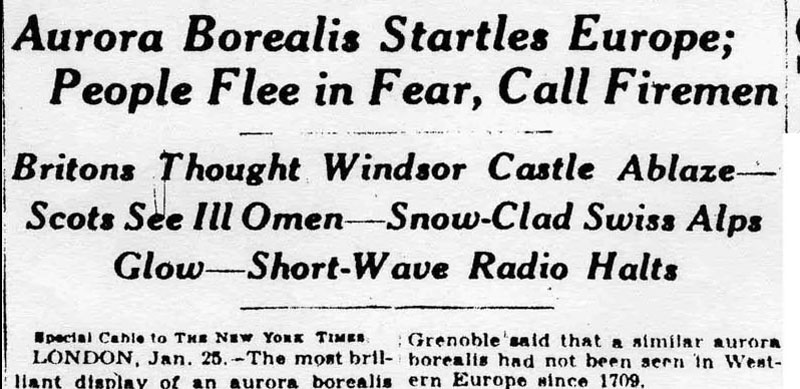
1938-aurora-borealis-new-york-times
 
by
 
 Damien F. Mackey
 
 
“The intensity of this extraordinary celestial spectacle, its splendid brightness, its enormous extent, its extreme rarity at this intensity especially in our regions, and even more so in this season of the year, seemed worthy to us of being pointed out to the Society immediately”.


Fatima 13th July, 1917:
 
‘When you see a night illumined by an unknown light, know that this is the great sign given you by God that he is about to punish the world for its crimes, by means of war, famine, and persecutions of the Church’.
 
The following eye-witness accounts of what pilots flying in the air at the time were to describe as “a shimmering curtain of fire” - including those accounts written up in the Bulletin of the Astronomical Society of France and Monthly Review of Astronomy of 1938 - reveal the apparently unprecedented nature of this terrifying doomsday phenomenon http://motheofgod.com/threads/aurora-borealis-of-1938.4360/
 
1.       Bulletin of the Astronomical Society of France and Monthly Review of Astronomy, Meteorology and Globular Physics”, in the year 1938.
An aurora borealis of exceptional beauty was visible in France and in almost all the countries of Europe, from the evening of Tuesday, January 25, 1938, to the morning of Wednesday, the 26th. In Switzerland, in England as well as in the regions of the West, Southwest and Southeast, right down to Provence, and even further south, in Italy and Portugal, in Sicily and Gibraltar, and even in North Africa, the phenomenon showed an exceptional intensity for these latitudes...
The atmosphere had been cloudy and there had even been a slight drizzle around dusk. The sun had been invisible all day. But now, more than two hours after sunset, the clouds are dispelled. The northeast, northern and northwest horizons light up as though dawn were going to break all over again. For practical purposes it is dawn... but a nocturnal dawn, with a strange light; it is the aurora borealis.
A pale, beautiful, greenish-blue light envelops the sky from northeast to northwest. Gradually, up above the sky turns fiery red and an irregular red arch appears. A sort of cloud tinged with purple condenses in the northeast and moves over towards the northwest, as if propelled by a mysterious breath. It folds over, undulates, dilates, vanishes and then reappears, while immense rays, whose colour passes from blood-red to orange-red to yellow, rise up to the zenith of the sky, enveloping the stars. The spectacle is enchanting and varied, animated with luminous palpitations, with extinctions and recrudescences.
In the streets there is panic. “Paris is on fire!” In several villages of the province firemen are mobilized...» «An immense blood-red glow was extending over the sky...»
The review then gives a great number of statements from its correspondents, both from France and from foreign countries. Here are some significant excerpts:
At the observatory of pic du Midi: «This remarkable aurora was the first ever observed from the station of pic du Midi. It constitutes a rare phenomenon for this latitude... The first impression was of a gigantic conflagration...»
At La Chapelle-Saint-Laud, in Maine-et-Loire, the teacher kept this description given by one of his students, aged ten: «Yesterday evening there was a great red cloud; it was like a sheet of blood, then the cloud grew larger, forming great red threads, which kept going up, and below that, white threads, like chalk lines.
In Oise, Mr. Henri Blain - at first believed that it was the grim reflection of a vast inferno... Many of the villagers, struck by the anomaly and intensity of the phenomenon, observed somewhat nervously from the window sills of their houses... These red glows were visible, then disappeared, and later on reappeared after a more or less lengthy period of time... These luminous manifestations sometimes went up very high in the sky, and in colour and luminosity they were absolutely comparable to the very vivid reflections of a violent, nearby inferno... The intensity of this extraordinary celestial spectacle, its splendid brightness, its enormous extent, its extreme rarity at this intensity especially in our regions, and even more so in this season of the year, seemed worthy to us of being pointed out to the Society immediately.
In Picardie: «At a quarter past five, noticed in the north-northwesterly direction a red glow which first attributed as being the result of a far-off inferno... Ten minutes later, the great purple spot was extending above our heads right up to Orion; other smaller and paler ones formed and disappeared in their turn. A few moments later, the blazing sky was being reflected in our faces; my wife, who was admiring the phenomenon at my side, appeared to me in a red reflection which seemed to me unreal. At a quarter to eight, the red glow reached its maximum intensity, almost the whole sky seemed to be on fire. A second drapery was quickly lit up, its luminosity was such that could tell the time on my watch. The spectacle was extraordinary. A brave peasant who had come near me to ask for news believed very seriously that it was announcing the end of the world!... The cocks, undoubtedly fooled by this unusual aurora, began crowing as though it were sunrise!
At the minor seminary of Caen, the students contemplated from their dorm a great red sheet, through which a few stars could be seen.
A witness from Vaucluse employs the same expression: «I was surprised to notice a great red sheet in the sky. For a moment it resembled a fire to me somewhere in the surrounding area, whose glowing light was reflected in the clouds… I observed that during the whole duration of the phenomenon the dogs in the village and surrounding area began barking and howling. They did not stop until about half past ten.
In North Africa this aurora borealis was so intense that an admiral whose ships were cruising near the coast ordered a destroyer to turn towards the left, towards the northwest, for he too believed that a fire was in the distance.
Another witness reports: This aurora was visible in almost all of Tunisia. It is a very rare phenomenon in our region since a similar one has not been recorded since 1891... In general it looked like a vast red or rose coloured glow, more or less streaked with white... The natives, who were very frightened, saw in it a warning of the divine wrath; the Europeans believed it was a huge, distant fire. The descriptions coming from various points in Tunisia always come back to the same expressions, which reveals that the phenomenon had an astonishing uniformity: «the sky turning red, a large reddish band which at first resembled a fire...», the «blazing sky», «a general blaze in the sky, the colour of a red brick, etc. The phenomenon was visible in all of North Africa.
In England: a witness spoke of moving pleats of a red velour coloured curtain. The curtain was drawn and filled the whole space. In Switzerland: a spring-like day had preceded the unprecedented, unforgettable phenomenon.»
The astronomical review gave some reports originating from Czechoslovakia and Romania:
Very frequent but brief conflagrations inflamed the sky right up to its zenith. It seemed that the fiery arch in the sky had come very low.
In Italy: A phenomenon extremely rare in our country.» It was visible at Pontevedra in Spain, In Portugal: Yesterday, for the first time in my life I observed a magnificent aurora borealis, a phenomenon very rare over here, which nobody can remember having seen for fifty years. At Lisbon and in all Portugal this phenomenon occasioned as much attention as surprise. Almost all the spectators believed that the sky was being lighted up by an enormous fire; and I myself believed the same thing at first. The apparition lasted almost two hours, from ten o’clock until midnight... Its colour was a more or less intense red.
In the United States, «this aurora was spectacular... Early in the evening my attention was drawn to the east by an enormous conflagration. Over a wide area the sky was alight with a red glow and I believed at first that a great fire was devouring Hampton Beach. The aurora was also observed in Canada.
The astronomer, Carl Stromer, reports that one of his correspondents in Norway, at the station of Njuke Mountain (Tuddal), signalled to him that he had heard noises «while the aurora was at its height and the sky seemed to be an ocean of flames... The observer and his assistant heard a curious sound coming from above them... which lasted about ten minutes, rose to a maximum and then vanished, following the fluctuations of the aurora’s intensity. This sound, which resembled the crackle of burning grass, was perceived in the same region, in the Tuddal valley, by Mr. Oysteim Reisjaa. Everything was perfectly calm on the mountain, and nothing could explain the production of this noise, neither the wind, which was not blowing, nor the telegraph lines, nor motors. Above the observatories, from all sides, there was not a murmur in the forest.
January 26 issue of Le Petit Dauphinois
Grenoble, January 25. – An atmospheric phenomenon of exceptional intensity was noticed this evening between seven-thirty and ten-thirty on the entire range of the Alps. This phenomenon manifested itself by an immense luminous trail which seemed to come from the sun, to unfold, fan-shaped, right up to its zenith. The breadth of the spectacle observed was such that the blazing sky resembled the brilliance of dawn. The people were astonished at first, then admired this celestial manifestation, which is rarely seen in these latitudes; then, as the phenomenon prolonged itself, they grew disturbed. Some curious scenes – especially in our countryside – were witnessed as the horizon remained purple. A thousand controversies swirled around this strange vision, which was believed to be a vast fire in the mountains, or gigantic military manoeuvres with searchlights; it was even believed – and this was the almost unanimous and not the least interesting observation – that the sun was going to rise...
Now according to the first news we obtained from qualified professors, teachers of meteorology, it was a splendid aurora borealis, the most beautiful one to manifest itself in western Europe for centuries...
From the city itself the phenomenon was not very well perceived. But as soon as one left the suburbs, even without thinking of looking out over Grenoble, in the north a gigantic blazecould be perceived.
At Le Petit Dauphinois all the telephone lines were jammed by our correspondents – even the most distant ones – who informed us of the celestial manifestation. At eight o’clock, this animation which was continually increasing changed on certain points into a real terror.
This next article also broaches the subject and provides some useful explanations http://www.fatima.org/essentials/whatucando/prophecyourtime.asp
 

Understanding Prophecies for Our Time


Saint Augustine said that we must pray as though everything depends on God and work as though everything depends on us. Thus, in addition to prayer, each of us has an obligation to act. Before one can take the appropriate action, however, one must be informed – about the Faith and about the prophecies God sends to guide us. St. Thomas tells us that God sends prophets to every generation, not to give us new doctrine, but to remind us what we must do to save our souls. ….
Saint Paul tells us: "Extinguish not the spirit. Despise not prophecies. But prove all things; hold fast that which is good" (1 Thes. 5:19-21). God sends prophets to set a straying world back on the right path, and we must not despise the prophecy that God has sent to us through His prophets.
 
Our Lady of Fatima gave us prophecies for our time: prophecies that are being fulfilled before our very eyes. For example, Our Lady predicted that if people did not amend their lives, a terrible war would begin during the reign of Pius XI. In addition to warning people to amend their lives and ask pardon for their sins, Our Lady offered a marvelous way to prevent the punishment of war: the solemn Consecration of Russia to Her Immaculate Heart. … people amend their lives … and World War II and the series of wars that followed it have resulted (Korea, Vietnam, Iraq, Kuwait, etc.). And more wars continue now and into the future – all because we ignore Our Lady of Fatima’s requests.
 
Some critics, including Father Edouard Dhanis, have argued that Sister Lucy’s prophecy that the "great war" would begin during the reign of Pius XI was incorrect. They make this claim because, as they say, the Second World War "began" with the German invasion of Poland on September 1, 1939 – as is widely and erroneously believed – when Pius XII, not Pius XI, was Pope. Pius XI died on February 10, 1939, and Pius XII was installed as Bishop of Rome on March 12, 1939.
Sister Lucy, however, has maintained that World War II, in truth, began during the reign of Pius XI. "The annexation of Austria was the occasion for it," she explained. The invasion of Austria (in March 1938), the annexation of Czechoslovakia, the formation of military alliances and the decision to invade Poland were the beginnings of the war, though war had not yet been officially declared. All of these events occurred during the pontificate of Pope Pius XI.
Furthermore, the "night illumined by an unknown light," which Our Lady said would signal the coming of the "great war", occurred during the night of January 25-26, 1938. On that night a bright red light, likened to the blaze of a gigantic fire, filled the evening sky, and was seen across Europe and even in parts of North America and North Africa. It was determined to be a most extraordinary aurora borealis. Sister Lucy expressed reservations on this, but wrote in her third memoir on August 31, 1941 that no matter what cause the light could be attributed to, "God made use of this to make me understand that His justice was about to strike the guilty nations…"
 
During the same night that the great sign appeared in the sky, in Moscow’s Lubianka prison a man by the name of Kristian Rakovsky was being interrogated by Josef Stalin’s chief interrogator. During the interrogation Rakovsky revealed Germany’s plan to dominate Europe. He proposed that the Soviet Union join Germany in an invasion of Poland, which would lead to Europe’s retaliation against Germany and not the Soviet Union. According to Rakovsky’s plan, France and England would wear each other out, after which the Soviet Union would turn on Germany and collect the spoils of the war. This fateful interview began at the same time the unknown light in the sky was beginning to fade. It resulted in the Soviet Union’s instigation of and participation in the war, and Rakovsky’s plan was carried out to the great benefit of the Soviet Union. Again, this decisive step toward World War II occurred during the reign of Pope Pius XI. 1
….
 
Notes:
1.       For a text of the Rakovsky interview, see Manifold, Deirdre, Firinne Publications, Galway, Ireland, 1993, pp. 26-52. Towards World Government: New World Order