Tuesday, March 24, 2020

Pope Francis calls on Christians worldwide to combat coronavirus pandemic with midday prayer on March 25


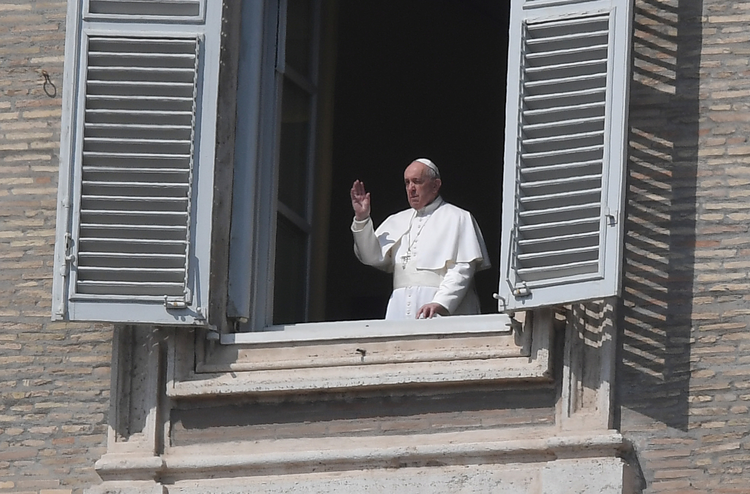
Pope Francis is seen in a window greeting a few nuns standing in St. Peter's Square at the Vatican March 22, 2020, after reciting his weekly Angelus prayer from the library of the Apostolic Palace. (CNS photo/Alberto Lingria, Reuters)
Pope Francis has called on the leaders of all the Christian churches, communities and confessions worldwide, as well Christians everywhere, to join together in praying the Our Father on March 25 to implore God to rid the world of the coronavirus pandemic that is wreaking havoc everywhere.
He also said that he would lead a prayer service from the front of St. Peter’s Basilica on March 27 and afterwards would offer a blessing “Urbi et Orbi”—“to the city of Rome and the world”—with the Blessed Sacrament.
Francis announced these two prayer events after midday on Sunday, March 22, after reciting the Angelus from the library in the Vatican’s Apostolic Palace, where he usually meets heads of state, religious leaders and distinguished persons.
“In these days of trial, as humanity trembles at the threat of the [coronavirus] pandemic, I would propose that all Christians join their voices together to heaven,” Francis told a virtual audience following on Vatican News Media.
“In these days of trial, as humanity trembles at the threat of the [coronavirus] pandemic, I would propose that all Christians join their voices together to heaven,” Pope Francis said.
Tweet this
“I invite the heads of the churches and the leaders of all the Christian communities, together with all Christians of the various confessions, to invoke the Almighty, the All Powerful God, by reciting contemporaneously the prayer that Our Lord Jesus has taught us,” he said.
“I therefore invite everyone to recite the Our Father at midday on March 25 next, on the day when many Christians recall the annunciation to the Virgin Mary of the Incarnation of the Word, so that the Lord may listen to the unanimous prayer of all his disciples that are preparing to celebrate the victory of the Risen Christ,” Francis said.
He also announced that he will preside over “a moment of prayer” from the steps of the basilica Saint Peter’s at 6 p.m. Rome time, next Friday, March 27. He said the square would be empty, but he invited people across the world “to participate spiritually” in this prayer which, he explained, would include readings from the Scripture and adoration of Jesus in the Blessed Sacrament.
He invited them to participate through “the means of communication,” that is, by television, radio or social media. He said that at the end of the prayer service he would give a blessing “Urbi et Orbi” with the Blessed Sacrament. Keen to share God’s mercy to people at this deeply troubling moment in human history, Francis said “the possibility of receiving a plenary indulgence” would be linked to the prayer service.
“We wish to respond to the pandemic of the virus with the universality of prayer, of compassion and tenderness.”
Tweet this
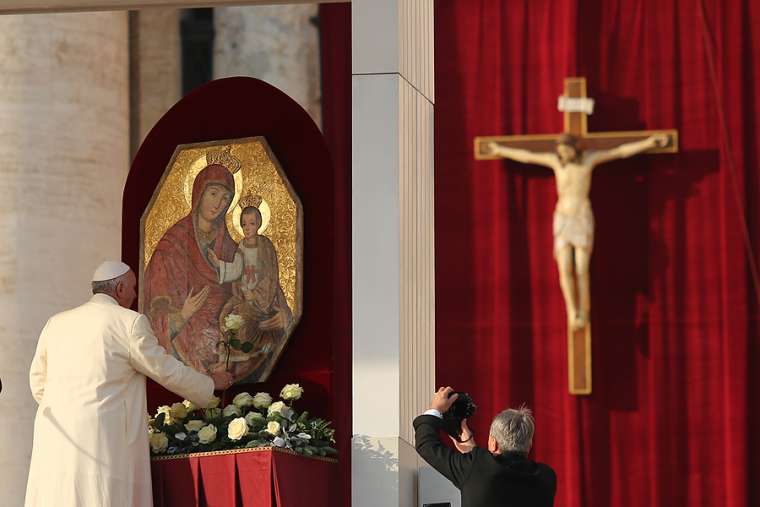
Pope Francis is of course deeply concerned about the spread of the pandemic and the terrible suffering it is causing to some 300,000 people and their families, as well as the fear it has provoked in countless millions across the globe, and the great damage it is doing also to the world’s economy. Last Sunday, he walked “on pilgrimage” on a deserted street in the center of Rome and prayed before two miraculous images, imploring God to rid the world of the coronavirus pandemic.
Today, he told his global audience: “We wish to respond to the pandemic of the virus with the universality of prayer, of compassion and tenderness.” He encouraged everyone: “Let us remain united. Let us make our closeness felt to those who are alone and to those who are most stricken.”
He told people, let us also express “our closeness to doctors, to health workers, nurses, volunteers” and “to the authorities that have to take hard measures, but ones that are for our good.”

He added, “let us show our closeness to the police, the soldiers who try to keep order always on the streets, so that the things the government orders for our good can be done,” indeed “let us be close to everyone.”

Thursday, March 12, 2020

Read: Pope Francis’s prayer to Mary during coronavirus pandemic


Pope Francis asks Mary's protection for Rome against coronavirus


          O Mary,
you always shine on our path
as a sign of salvation and of hope.
We entrust ourselves to you, Health of the Sick,
who at the cross took part in Jesus' pain, keeping your faith firm.
You, Salvation of the Roman People,
know what we need,
and we are sure you will provide
so that, as in Cana of Galilee,
we may return to joy and to feasting
after this time of trial.
Help us, Mother of Divine Love,
to conform to the will of the Father
and to do as we are told by Jesus,
who has taken upon himself our sufferings
and carried our sorrows
to lead us, through the cross,
to the joy of the resurrection. Amen.
Under your protection, we seek refuge, Holy Mother of God. Do not disdain the entreaties of we who are in trial, but deliver us from every danger, O glorious and blessed Virgin.
https://www.americamagazine.org/faith/2020/03/11/read-pope-francis-prayer-mary-coronavirus-pandemic 

Tuesday, January 7, 2020

Miserific Face of Satan


The picture in question. Picture: Channel 7


by


Damien F. Mackey


“Now there are a thousand times ten thousand roads down which any one of us may travel for a lifetime, But all of those roads are going to end in front of two faces.

One, the Merciful face of Christ. And the other, the miserific face of Satan”.


~Archbishop Fulton Sheen


Craig Calvert isn’t into “hooky pooky stuff” but there was no mistaking this.

There, in a photo his friend took, was a “big devil face” emerging from a raging fire in Victoria’s East Gippsland region.

The dairy farmer spent 13 hours defending his property from a fire that spat out 100 metre large fireballs.

“It hit us like four or five times, the chopper pilots are heroes, they saved it (the property) …I’m very glad people did not get killed here,” he told Channel 7.

“We had fireballs coming over, jumping. Some of them were 50 metres to 100 metres across.

“We’ve got a photo a friend took and I’m not into hooky pooky stuff but there was a big devil face in it.”


What is the Essence of the Demonic? by Archbishop Fulton Sheen


Scott Brossart·Tuesday, 3 December 2019·Reading time: 3 minutes


"What then is the demonic? The demonic is the temptation away from the Cross of Christ in redemption. That's the essence of the demonic. This is an example of the demonic: taking down of crucifixes from our hospital rooms, from our school rooms. I went to a bishops' meeting in the convent and the sister was, well she didn't look like a sister, but she said she was. But the essence of the demonic is the anti-Cross and all that it means. It means sin, it means redemption, it means glorification, it means resurrection, it means an eternal peace and joy, but not the Cross. So we have movements in the Church today where we have this spirit without a Calvary. No mention of a Cross or of discipline. Just the celebration. It is because we know what clear water is that we are offended by foul waters. It is only because we know Christ that we begin to see evil in its depth because evil is relational. Evil has no substance of its own. It is a parasite on goodness. And the more Christlike we are, the deeper is our vision of the evils of the world and the evils that can creep into the Church. How long this conflict with evil forces will last, well we do know, but now it is intensifying and it centers so much on the Eucharist which brings us to the necessity of the Holy Hour. I don't know if you have many tabernacles robbed in this diocese, but we do. In one diocese there were two country parishes within 7 miles of one another where the Blessed Sacrament was stolen, corpuses torn of the crucifixes. No Christ on the Cross. There must be a consecrated host for a Black Mass, that is an absolute essential. It is where everything will be done backwards. The Our Father will be said backwards, prayers will be said backwards.


And when the priests join the movement, they have the Body of Christ to recrucify. We may be a little lax in our devotion to the Blessed Sacrament, but Satan is not.

Scripture tells us that Satan believes. He believes and therefore he seeks Him out. And this then, is an additional reason for the Holy Hour. One bishop jokingly said, "That means I must give up my alcoholic drinking hour in order to have my Holy Hour." Now there are a thousand times ten thousand roads down which any one of us may travel for a lifetime, But all of those roads are going to end in front of two faces. One, the Merciful face of Christ. And the other, the miserific face of Satan."

~Archbishop Fulton Sheen


Maybe, when one legislates against Creation - as has recently been the case in Australia (extreme abortion laws; euthanasia; yes to gay ‘marriage’) - then Creation may legislate against the legislator.


The fires that have been raging all the way down the eastern side of Australia have become so fierce and unstoppable that standard descriptions such as “bushfire” have had to be replaced with words like “atomic”.


“Up until an hour or so ago it was pitch black, you couldn’t see 10 feet in front of you. It was just insane”.


The Rural Fire Service said firefighters were in "uncharted territory" at the peak of the crisis ….


… with one responding to footage of the NSW “megafire” with …. “This looks like hell.”


"Within 30 minutes this great wall of fire just came from the back of our cul de sac and within seconds the trees were catching fire, and the sky was orange and yellow. It was like Armageddon …".


MidCoast Mayor David West, who lives in Brimbin, said that he had never seen anything like the nearby fire.

"I'm looking at a sky that's screaming danger, that's saying 'get out of my way, I'm going to kill you'," he said.

"I know that sounds melodramatic but it's not. This is a fire that's devouring everything in its path."


1 John 3:2 Dear friends, now we are children of God, and what we will be has not yet been made known. But we know that when Christ appears, we shall be like him, for we shall see him as he is.

Tuesday, December 17, 2019

On the Maccabees and Bar Kochba


 Image result for bar kokhba"

 
by
 
Damien F. Mackey
 
 
“… your conclusion: “Judas the Galilean” who “appeared in the days of the census”, according to Gamaliel, may just be that required link between the Maccabees and the census of Luke 2." seems "minimalistic" after many findings here and there.
What are historical implications of your findings?
 
A Reader


This particular correspondent has written in full, commencing with reference to my article:
 
Maccabees need to be greatly lowered on the time scale
 
https://www.academia.edu/36414256/Maccabees_need_to_be_greatly_lowered_on_the_time_scale
 
 
Hi Damien,

I read your article on Maccabees, which does record several interesting literary parallels.

But your conclusion: “Judas the Galilean” who “appeared in the days of the census”, according to Gamaliel, may just be that required link between the Maccabees and the census of Luke 2." seems "minimalistic" after many findings here and there. What are historical implications of your findings?

That Maccabees did not exist as well as Bar-Kochba? That the only historical character was Judah Ha-Galili mentioned in Acts? That all Books of Maccabees are of the 1st century CE?

But Josephus, born in 37 CE and who claimed descent from Maccabees, lived not far from this time - why did he contribute to the confusion?

And why Bar-Kochba (or bar-Koziba as per Talmud) is mentioned at all? Why Sephoris is Modiin? You must prove you know Hebrew when you talk about Jewish history by finding a common etymology of two different words.

Talmud is not just "Jewish legends" as you wrote. It is important collection of historical facts. In my article about Encounter, I show that Talmud is more trustworthy than e.g., Josephus who was prong to "edit" his sources when needed.

The Second Temple of Herod was of marble. The one built by Zerubavel - of wood. Which "unworthy notion" do I create here?

….

PS As for Elijah I have an opinion that he was not an "angel" but was simply murdered by Elisha.

PSS I may agree that Haman is a purely mythological figure and many could be his prototype.
….


Damien Mackey replies:
 
….
You are like various people I have encountered over the years who read one or more of my articles and then criticise me for things that I have never actually written or thought. "... a thing which I never ... spoke of, nor did it ever enter my mind," (Jer. 19:5).

Maccabees DID exist, as well as Bar Kochba. (The dating/era just needs to be corrected) - see e.g. my article:

"A New Timetable for the Nativity of Jesus Christ"
https://www.academia.edu/36672214/A_New_Timetable_for_the_Nativity_of_Jesus_Christ
 
Gamaliel's Judas WAS Judas Maccabeus, but Gamaliel gives an appalling description of the great man as if he were a mere flash in the pan. Nor any mention by G. of Judas's mighty brothers after him, Jonathan and Simon (who, incidentally, is marvellously described in Sirach 50:1-21).

Sepphoris as Modein ("declarers") is a highly tentative connection (no name likeness claimed here). Logically, however, if Judas the Galilean were Judas Maccabeus whose ancestral home was Modein, then Modein might well be Sepphoris, the base for Judas the Galilean.

After all, archaeologists cannot find the elaborate Maccabean tomb (I Maccabees 13:27-3) at the presumed 'Modein' near Tel Aviv.

Re Zerubbabel's Temple of Yahweh: "'The glory of this present House will be greater than the glory of the former House',” said the Lord" (Haggai 2:9).

You have turned it into a log cabin.

"Haman ... a purely mythological figure"?
I prefer the legends of the Jews that accord him historical reality, as a Jew. He was a long-lived King of Judah.

Damien.


Friday, December 13, 2019

An academic exchange regarding Hadrian and the Bar Kochba Revolt


 Image result for simon bar kokhba"

 
by
 
Damien F. Mackey
 
 
“But if the Temple is indeed depicted on the Bar Kochba coins (e.g., as a national symbol) then there is a way to check your hypothesis - "our" Bar Kochba could depict only magnificent Herod's Temple, while "your" Bar Kochba - only the previous one, a puny hut”.
Canadian Reader’s comment
 
 
Canadian reader:
 
…. Is your paper [not referenced by this reader] academic? Much of what you write is known. See e.g., this paper which can be also found on Academia:
Cheers ....
 
Damien Mackey:
But then you're quite wrong in writing that: "Much of what you write is known".
Who else today, but I, writes about Epiphanes as Hadrian (supposed to be some 300 years apart)?
Or who else argues that there was no Second Jewish Revolt after the First one?
….
 
Canadian reader:
 
Damien, I am missing something.
 
….
>The so-called Second Jewish Revolt is actually, rather, the revolt of the Maccabees (e.g. Simon) during the reign of Epiphanes.
 
Do you mean there was no Bar-Kochba revolt?
….
 
Maccabees 4 is of late origin. What's the point arguing from that? It could have been written after 135.
 
The usual nomenclature is the First revolt of 66-70 and Second of 132-135. Are you saying one of them was never happen?
….

Damien Mackey:
 
Absolutely … I am saying that the 'Second' Revolt did not - no, could not - have happened as there was nothing left to destroy after 70 AD, with the city and Temple burned to the ground and the people either killed or taken into captivity.

How could the Jews have launched a massive war of resistance not so very long after that!
Hadrian, who Jewish legend has in place of Antiochus Epiphanes (because Hadrian WAS Antiochus IV), was not a contemporary of a later revolt, but of an earlier one, the Maccabean revolt.

That is why the coins of Simon Bar Kochba (presumably Simon Maccabee) have the Temple of Yahweh represented on one side. What would have been the point of that if the Temple was no longer standing?
….
 
Canadian reader:
 
Well, do you read Hebrew, Damien? Just for a record.
 
Jewish history does not claim Bar- Kochba operated from Jerusalem but rather from the small fortified cities like Beitar conducting a partisan war.

But if the Temple is indeed depicted on the Bar Kochba coins (e.g., as a national symbol) then there is a way to check your hypothesis - "our" Bar Kochba could depict only magnificent Herod's Temple, while "your" Bar Kochba - only the previous one, a puny hut. ….
 
Damien Mackey:
 
Yes … I have studied Hebrew at University level and won a Jewish prize for it.

If Bar Kochba was Simon Maccabee, as I am maintaining, then Jewish history (Maccabees 1 and 2) has he and his brothers), perhaps based in Modein, operating all over the land.

I know of only two Temples of Yahweh: (i) that of Solomon, and (ii) that of the era of the Persians (Cyrus and Darius). See e.g. my article:
 
“‘… there shall not be left one stone upon another’. How to explain Jerusalem today?”
 
My best wishes,
Damien.


Thursday, November 28, 2019

Pope Francis: 'There is corruption in the Vatican'


?Documentary Video: Holy Money - Vatican City Corruption

Pope Francis admitted that there is financial corruption in the Vatican. He said an ongoing internal investigation into the corruption at the Vatican would "see if they are guilty or not."


Pope Francis admitted there is financial corruption in the Vatican, describing it as a "scandal" on Tuesday. The pope's statement marked the first time he has acknowledged corruption in Vatican finances.


"There is corruption, it's clear. With the interrogations we will see if they are guilty or not. It is an ugly thing, it's not nice for this to happen in the Vatican," Francis said during an in-flight press conference on the way back from Japan.


Read more: Opinion: A synod that could make history


The pope told reporters that there was a Vatican investigation underway into the allegedly fraudulent use of the Peter's Pence, the pope's charity fund, to buy a luxury property in central London. The pope has previously said that such a purchase is not necessarily a misuse of charity funds.


"What happened, happened: a scandal. They did things that do not seem clean," the pope said.


These were the first public comments made by Pope Francis on the issue of financial corruption. The pope stressed that the internal investigation was going well.


"For the first time, the dirt is being uncovered from within the Vatican, rather than from outside," Francis said.


https://www.dw.com/en/pope-francis-there-is-corruption-in-the-vatican/a-51431279

Wednesday, November 6, 2019

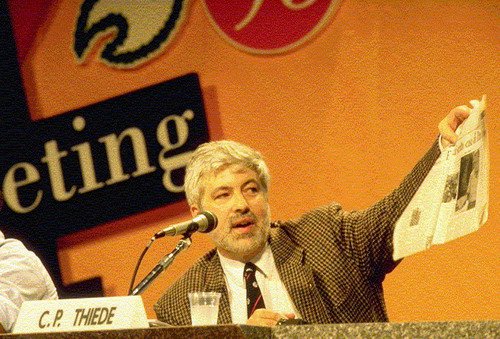
Carsten Peter Thiede’s early dating of Matthew’s Gospel


Thiede Carsten Peter


“The neomodernist stranglehold is exemplified by the treatment accorded Fr. Jean Carmignac, who died in 1986. Perhaps the greatest French Bible scholar of the century, who dated the writing of each of the four Gospels between A.D. 40 and 50, he was never allowed to publish
his research, on orders of the French bishops. They accused Carmignac of "an obsession of struggling against the majority of exegetes".”
 
Paul Likoudis


Then came Dr. Carsten Peter Thiede with his dramatic evidence for a radical early dating of the Gospel of Matthew. We read a little of it in the following account:


Christmas Eve 1994 would have come and gone like any other, had it not been for three tiny papyrus fragments discussed in The Times of London’s sensational front-page story. The avalanche of letters to the editor jarred the world into realizing that Matthew d’Ancona’s story was as big as the discovery of the Dead Sea Scrolls. The flood of calls received by Dr. Carsten Peter Thiede, the scholar behind the story, and the international controversy that spread like wildfire, give us an inkling as to why the Magdalen Papyrus has embroiled Christianity in a high-stakes tug-of-war over the Bible.
 
Thiede and d’Ancona boldly tell the story of two scholars a century apart who stumbled on the oldest known remains of the New Testament–hard evidence confirming that St. Matthew’s Gospel is the account of an eyewitness to Jesus. It starts in 1901 when the Reverend Charles B. Huleatt acquires three pieces of a manuscript on the murky antiquities market of Luxor, Egypt. He donates the papyrus fragments to his alma mater, Magdalen College in Oxford, England, where they are kept in a butterfly display case, along with Oscar Wilde’s ring. For nearly a century, visitors hardly notice the Matthew fragments, initially dated to a.d.180-200; but after Dr. Thiede redates them to roughly a.d. 60, people flock to the library wanting to behold a first-century copy of the Gospel.
 
But what is all the fuss about? How can three ancient papyrus fragments be so significant? How did Thiede arrive at this radical early dating? And what does it mean to the average Christian? Now we have authoritative answers to these pivotal questions. Indeed, the Magdalen Papyrus corroborates the tradition that St. Matthew actually wrote the Gospel bearing his name, that he wrote it within a generation of Jesus’ death, and that the Gospel stories about Jesus are true. Some will vehemently deny Thiede’s claims, others will embrace them, but nobody can ignore Eyewitness to Jesus.
[End of quote]
 
Paul Likoudis, writing for EWTN in 1997, has more to say on the matter.
I (Damien Mackey) would not necessarily agree with him, though, that “Matthew's is the first Gospel”. Fr. Jean Carmignac (mentioned in this article) made an excellent case for (if I recall correctly) Mark’s being basically the Gospel of St. Peter – and therefore the first gospel - translated by Mark into Greek.
 
New Book Claims Four Gospels Written Before Fall Of Jerusalem
 
….
 
The hundred years' war on the Gospels-led by Rudolf Bultmann, who charged that "we can know practically nothing about Jesus' life and personality," and escalated by some of the most prominent Catholic Bible scholars working today-has produced the intended results of religious indifference, agnosticism, and atheism.
 
Typical of the Bultmann-inspired Catholic exegetes is Fr. Jerome. Murphy O'Connor, O.P., who, writing in the December, 1996 issue of the Claretians', pontificates that the Gospels are "mythical embellishments," that Jesus didn't know He was God and didn't know where His power came from, that Mary considered Him an embarrassment to the family, that she was not at the foot of the cross as the evangelists relate, and more.
 
"Do the Gospels Paint a Clear Picture of Jesus?," he asked. Definitely not, he tells his students and readers.
 
At the core of the dissident biblical exegesis which has produced such disastrous consequences for Catholic life, liturgy, catechetics, and scholarship is a refusal to believe that the Gospels were written by eyewitnesses of the events described.
 
Though there has been no shortage of genuine Catholic exegetes, archaeologists, and historians who have insisted on an early dating of the Gospels to within a decade or two of Jesus' life, these scholars have often found it difficult to break through the controls put in place by an oppressive neomodernist establishment in both Catholic and Protestant institutions.
 
(The neomodernist stranglehold is exemplified by the treatment accorded Fr. Jean Carmignac, who died in 1986. Perhaps the greatest French Bible scholar of the century, who dated the writing of each of the four Gospels between A.D. 40 and 50, he was never allowed to publish his research, on orders of the French bishops. They accused Carmignac of "an obsession of struggling against the majority of exegetes.")
 
Now comes a German scientist, Carsten Peter Thiede, director of the Institute for Basic Epistemological Research in Paderborn, who, with Matthew D'Ancona, is about to dash to pieces the Bultmann-built edifice of modernist exegesis.
 
Their recently published book, (Doubleday, 1996), is about a small piece of papyrus held at Magdalen College, Oxford, which is the oldest fragment of in existence today.
 
The fragment contains disjointed segments of 26, but even more important than the writing style, which Thiede pinpointed to the time of Jesus' life, is the use of KS, an abbreviated form of [missing], to refer to Jesus as Lord God- meaning that the ancient author believed that Jesus is divine.
 
Thiede, a papyrologist, furthermore concludes that must have been the first Gospel written.
The implications of this are enormous. As Thiede and D'Ancona write in their book:
 
"Bultmann was wrong: The authors of the Gospel could hear far more than the faintest whisper of Jesus' voice.
Indeed, the first readers of may have heard the very words which the Nazarene preacher spoke during his ministry, may have listened to the parables when they were first delivered to the peasant crowd; may even have asked the wise man questions and waited respectfully for answers. The voice they heard was not a whisper but the passionate oratory of a real man of humble origins whose teaching would change the world."
 
The issue of the dating of the Gospels has implications, furthermore, for believers and nonbelievers alike. "... We have come to realize the extent to which this new claim is directly relevant to the fundamental faith questions which all people, Christian and non-Christian, atheist and agnostic must ask themselves. The redating of the fragments, in other words, has a life beyond the confines of the academy. . .
"The redating of the Gospels- a process which is only now beginning in earnest-may seem an enterprise appropriate to its times, to the mood of the millennium's end. There is now good reason to suppose that the [missing], with its detailed accounts of the Sermon on the Mount and the Great Commission, was written not long after the crucifixion and certainly before the destruction of the Temple in A.D. 70; that the was distributed early enough to reach Qumran; that the belonged to the first generation of Christian codices; and that internal evidence suggests a date before A.D. 70 even for the nonsynoptic .... These are the first stirrings of a major process of scholarly reappraisal."
 
International Upheaval
 
Thiede's findings are causing an international upheaval among Bible scholars, particularly Catholic exegetes who have bought the Bultmann line that separates the Gospels to a generation or more from Jesus' contemporaries (making them the unreliable voice of an uncertain community) ….
 
Two hundred years ago, one of the leaders of the Enlightenment, Reimarus, described the task of Church-haters to be to "completely separate what the Apostles presented in their writings (i.e., the Gospels) from what Jesus himself actually said and taught during his lifetime."
….
 
Footnote
 
Among the brief sections of the Gospel on the Magdalen fragment is: "Then one of the XII, who was called Judas Iscariot, went to the chief priest and said, 'What will you give me for my work?'"
….