Showing posts with label Pope Francis greedy bankers financial speculation Karl Marx loaves and fishes. Show all posts

Thursday, January 8, 2015

No salvation outside the Church


Fr David Watt 


In offering a few thoughts on this well-known dogma, I will be drawing extensively on material from Fr Brian Harrison OS, both published (Living Tradition nos 149 and 150) and unpublished.  Apart from the Magisterial data and classical authors, of all I can remember reading, the work of Fr Harrison has been far and away the most illuminating.  No surprise there, since I know of no finer theologian active in the Church today. 


Though we do have our differences.  For example, of catechumens Fr Harrison says they are in porticu Ecclesiae; neither inside nor outside the Church.  I believe Fr Harrison and I are in agreement about the underlying reality here, which of course is far more important than the actual terms we use.  Nevertheless I find his terminology infelicitous.   To the best of my knowledge it has not been employed by any Magisterial document, Doctor or Father of the Church.


To justify what, as I say, appears to be novel terminology, Fr Harrison asks ‘When you are in the portico of St Peter’s, are you inside or outside the Basilica?’ – to which he replies Neither, for the boundaries have not been defined with sufficient exactitude for either answer to be accurate.  My reply:  you can be said to be inside or outside, depending on what is meant by St Peter’s Basilica.  One person may take the term as meaning what might be called the greater Basilica, in which case you are inside, whereas for someone else, the Basilica proper does not begin until the doors, in which case you are outside.


Fr Harrison however may press the point by saying What if you have one foot inside the building and one foot outside? – then, surely, you cannot be said to be either inside or outside. I agree, in the sense that you are not completely inside or outside.  Or to put it another way, you are partially inside and partially outside.  That is because a body has extension.  But you cannot extend this to set-membership, on pain of infringing the Law of the Excluded Middle.  For example, you cannot be partly a member of a chess-club, or neither inside nor outside the club.  Now the language of Tradition about membership of the Church is surely much more akin to being in a club than to being partly inside a building.  No one ever speaks of being partially Catholic.


How then does the Tradition deal with the case of catechumens? 


For eg St Robert Bellarmine and Pope Pius XII, they are outside the Church (though not in the sense excluding from salvation) whereas in Vatican II (Lumen Gentium 14) they seem to be already inside.  The apparent contradiction is resolved by the definition of Church being broader in one case than in the other.  (One traditional formulation is that certain people may belong to the soul of the Church while not belonging to her body.)


Indeed, much of the confusion surrounding the dictum Extra Ecclesiam nulla salus – no salvation outside the Church – would appear to be terminological.  Take the case of someone validly baptized as an adult into a virulently anti-Catholic sect; let us suppose that, whatever other mortal sins he has committed, his heresy, at least, is material rather than formal.  In the more common acceptation of the word, he would not be called a Catholic, and yet, since there is only one true Church, if he has indeed been validly baptized, he must have been baptized into that Church, and so it must be correct, in a sense, to describe him at that moment as a Catholic, albeit one who is badly-instructed and possibly even ill-disposed.


It is clear from the work of Fr Harrison that in the phrase ‘no salvation outside the Church’ the sense of ‘Church’ needs to be quite broad.  Nevertheless, from his writings we can glean cogent reasons for not making the term so broad as to include adults who die without ever explicitly professing faith in Christ.  The reward for obeying the grace to follow one’s conscience is that God will provide, if need be in a miraculous way, the opportunity to make an act of explicit faith in Christ before dying.


Not that this should slacken our resolve to share the Catholic Faith.  As Fr Harrison and Dr Ralph Martin agree, we need to be far more active here, knowing that although salvation is just as possible for an adult who dies without ever being consciously Catholic, ceteris paribus it is far more improbable (1 Pet. 4:18). Someone unaware that the Catholic Church is the One True Church will obviously not be able to access all the aids to salvation that are to be found only in her.   It is for this reason that Vatican II promotes the missions with ‘sedulous care’ (Lumen Gentium 16).
________________________________________________________________

Sunday, December 14, 2014

A Catholic Revival in Northern Europe


Northern Europe has become one of the world’s least religious regions. British Prime Minister David Cameron, a Conservative, has legalized same-sex “marriage” and said that he opposes abortion. . .after twenty weeks of pregnancy. A decade ago, Scandinavian Christian Democrats, whose national flags contain crosses, opposed including references to Christianity’s role in European culture in the European Constitution’s preamble. In today’s Britain and Scandinavia, laissez-faire morality is the reigning political dogma and religious apathy is the dominant worldview.
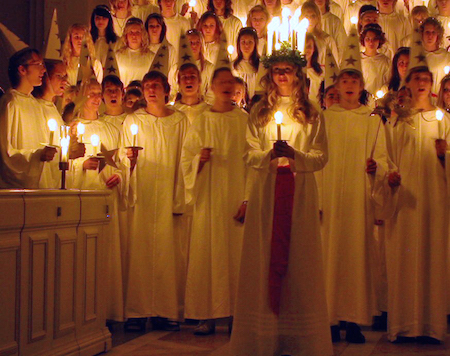
At the same time, the state churches of the region have retained some social importance. In Britain, the queen remains head of the Church of England, while Anglican bishops are peers in the House of Lords. Meanwhile, polls consistently show that levels of trust in the Lutheran Church are high in Scandinavia. Most Scandinavians are baptized, married (if they marry – over  half of births are to non-married couples), and buried by state churches. In Sweden, most families light Advent candles and St. Lucy’s Day processions remain popular.
André Malraux predicted that the 21st century would be religious, or it would not be at all. Sociologists note that, even in secularized societies, people thirst for things spiritual. Despite the aforementioned social and cultural visibility of Protestantism in Northern Europe, however, the Lutheran and Anglican Churches there are dying. British sociologists predict that practicing Anglicans will soon meet the fate of the Dodo and woolly mammoth, falling from 800,000 to just 50,000 by mid-century (Episcopalians face similar disastrous prospects in North America). In Sweden, 4 percent of Lutherans attend services regularly, while the corresponding figures in Norway and Finland are below 2 percent.
By contrast, the Catholic Church is experiencing a mini-renaissance in Northern Europe. There are currently more practicing Catholics than Anglicans in Britain. In Scandinavia, there are about 600,000 Catholics, roughly 3 percent of the region’s population (a proportion similar to that of Catholics in Asia). Certainly, part of this has to do with immigration. Since the European Union expanded to include less prosperous former East Bloc states in 2004, Scandinavia and the British Isles have been deluged by immigrants from the Catholic nations of Poland (2.2 million Poles have left their country in the past decade), Slovakia, Croatia, and Lithuania.
While Mass is celebrated in Polish or Serbo-Croatian across Northern Europe, the region’s indigenous population is also being drawn to the Catholic Church. In the past decade, the number of British seminarians has grown fourfold. This cannot be explained by immigration (young Polish immigrants who enter seminary usually go home) or by short bursts of enthusiasm, such as that after Pope Benedict XVI’s visit in 2010, as this upward tendency has been ongoing for ten years.
Currently, Scandinavia is one of the most vocations-rich regions in the Northern Hemisphere. The Church has 103,000 members in Sweden and 17 seminarians. By contrast, the Archdiocese of Vienna has thirteen times as many faithful but fewer than twice as many men studying to be priests.
 
A St. Lucy's Day celebration in Sweden
A St. Lucy’s Day celebration in Sweden
 
In 2009, the relics of St. Thérèse of Lisieux traveled across Britain, attracting the largest English pilgrimages since the Middle Ages. Young British Catholics are creating new initiatives such as the annual St. John Paul II Walk pilgrimage. The sacrament of reconciliation is making a comeback in the Isles: the number of British Catholics attending confession has mushroomed by two-thirds since 2010.
In Scandinavia, the Neocatechumenal Way – a mission-focused community founded by Spanish painter Kiko Argüello – is playing a key role in evangelization. Denmark, a country with just 40,000 Catholics, has 18 Neocatechumenal seminarians, while Finland, with just 10,500 Catholics, has 15. Meanwhile, a growing number of Scandinavians are becoming nuns; their number has inched up to 680. Cloistered orders are particularly successful in attracting new members. There is one nun for 880 Catholics in the region; in the United States, the corresponding number is one per 1,400. However, the number of American nuns is rapidly declining, while female religious are growing in Scandinavia.
Northern Europe is proving to be fertile ground for converts. In 2009, Pope Benedict XVI created the Personal Ordinariate of Our Lady of Walsingham, allowing Anglican priests to cross the Tiber. Since then, many Anglican clerics, frustrated with Canterbury’s eschewing of tradition, have done so. Scandinavian converts are hoping that the Vatican will create a similar ordinariate for Lutherans. Meanwhile, one of Scandinavia’s best-known Christian leaders – charismatic pastor Ulf Ekman – recently converted to Catholicism along with his wife. He said that the Catechism of the Catholic Church is the best book he has ever read.
Northern Europe is clearly one of the world’s most Godless regions. Yet, at the same time, the Catholic Church, while a minority denomination, is experiencing a revival that only Counterreformation popes could have dreamed of. There is an important lesson to be drawn from this.
As Christ said, His followers are to be the salt of the earth. The Lutheran and Anglican Churches have long lost their taste. Other than some fading rituals, they have become largely indistinguishable from the broader secular culture. The fact that the Lutheran bishop of Stockholm is a practicing lesbian perhaps best epitomizes what has happen to Northern European Protestantism. Catholicism has always been countercultural, and while political climates and intellectual currents have changed, it has retained its belief in one moral truth. Despite the pressures by some Catholics, the Church has remained steadfast in its proclamation of truth even while that truth has been unpopular.
Many have jokingly said that the Church of England is the Tory Party at prayer. Today, the Church of England and Lutheran churches are secularism at prayer. From teachings on life and marriage to women’s ordination, Northern European Protestant churches have made it seem that morality is something changeable. This makes such churches seem less credible. Yet spiritually hungry hearts like Ulf Ekman and the ex-Anglicans Catholic priests want something more. They want a Church more interested being coherent in its teaching than in receiving praise in the New York Times.
 
....
 
Taken from: http://thecatholicthing.org/2014/11/29/a-catholic-revival-in-northern-europe/


Wednesday, December 10, 2014

Communion of Reparation and the Super Cyclone

….

During the super cyclone that hit the Eastern seaboard of the Philippines, almost all the parishes the diocese of Tacloban sustained heavy damage.


All except one: the parish where a First Friday Eucharistic Adoration was going on at the time of the storm. This parish had been practicing the Communion of Reparation, a devotion which begins with an evening first Friday Mass, through nine hours of Adoration and rosaries, and closes with a midnight first Saturday Mass… as inspired by Our Lady of Fatima’s requests.


….


Taken from: http://catholicstand.com/dont-turn-fatima/

Tuesday, December 9, 2014

"The Fatima lifestyle is a shield of the Church for these perilous times".


• May 15, AD2014
 
Did you hear the true story of the Nagasaki atomic bomb survivors? Fr. Hubert Schiffer, SJ and at least four other Jesuits were living in quarters eight blocks away from the epicenter of the bomb. They miraculously survived the bomb blast and Fr. Schiffer lived for at least fifty more years without a trace of radioactive side effects. Fr. Schiffer attributes the miracle in his own words as related by Fr. Paul Ruge O.F.M.I, “We believe that we survived because we lived the message of Fatima. We lived and prayed the rosary daily in that home.”
The Message of Fatima
‘Fatima’ refers to the Church approved apparitions of Mary in 1917 to three shepherd children in Portugal for a period of six months. The children were given messages concerning world events and the miracle of the sun capped the end of the public apparitions. Through St. Jacinta, St. Francisco and Bl. Lucia (the seers), the Church was introduced to the Immaculate Heart of Mary, entreated to pray the rosary daily, and encouraged devotion known as the Communion of Reparation where the faithful assist First Saturday Masses in reparation to the offenses committed against the Immaculate Heart of Mary. Mary also begged the world to stop offending the Lord and to make sacrifices so that sinners would be saved. She promised that if her requests are heeded, “a period of peace will be given the world… and in the end, my Immaculate Heart will triumph.”
The alarming Fatima prophecies centered around world wars, the Pope\’s assassination and the danger of Russia’s communistic influence. Today, it is tempting to dismiss that the A-bomb of Nagasaki, the crumbling of the Berlin wall and St. Pope John Paul II’s consecration of the world closed the case for Fatima’s relevance. However, St. Pope John Paul II’s successors didn’t think so. Pope Benedict XVI on May 13, 2010 in a Mass at the Fatima shrine said:
“We would be mistaken to think that Fatima’s prophetic mission is complete.”
After him, Pope Francis, not even a year into his papacy requested Our Lady of Fatima’s statue to be brought to St. Peter’s square. On October 13th, 2013 (the feast of Our Lady of the Rosary and anniversary of the last apparition), Pope Francis consecrated the world to Mary.
The threat of China and North Korea’s communism over Asia, Russia’s re-appearance in world events, middle east instability, killing of the innocent unborn, and universal Church persecution should alert us that this period of peace is not among us yet. What we see, in fact, looks more like the cusps of a brewing storm of global mayhem. Current events make for a compelling case of why we still need to listen to and live out Mary’s message in Fatima. We put our own future at risk if we turn our backs on Fatima.
Living Out the Fatima Message
The Fatima lifestyle ushers in the reign or triumph of Mary\’s Immaculate Heart, a precursor to the coming of Jesus’ kingdom on earth. St. Louis de Montfort once prophesied: “His [Jesus] kingdom will come.   But this will happen only after the Blessed Virgin is known and has begun to reign…She gave him birth the first time. She will bring Him forth to us when He comes to us again.”
How do we live out the messages of Fatima?
  1. Pray the rosary daily
  2. Follow Pope Francis’ example and consecrate ourselves to Mary
  3. Practice the Communion of reparation for First Saturdays
  4. Make penance and sacrifices for sinners
The Fatima lifestyle is a shield of the Church for these perilous times. During the super cyclone that hit the Eastern seaboard of the Philippines, almost all the parishes the diocese of Tacloban sustained heavy damage. All except one: the parish where a First Friday Eucharistic Adoration was going on at the time of the storm. This parish had been practicing the Communion of Reparation, a devotion which begins with an evening first Friday Mass, through nine hours of Adoration and rosaries, and closes with a midnight first Saturday Mass… as inspired by Our Lady of Fatima’s requests.
 
....
 

Thursday, November 20, 2014

Conservatives defend Pope Francis


ROME — So far, Pope Francis’ most significant internal opposition has come from conservative Catholics alarmed over what they see as playing fast-and-loose with Catholic doctrine. This week, however, an all-star lineup of conservatives gathered in Rome has come to the pope’s defense.
“I am a conservative politically,” said Princeton University law professor Robert P. George, considered one of America’s most prominent Catholic commentators. “But I’m a Pope Francis Catholic, which is simply to say that I’m a Catholic.”
Harvard law professor and former US Ambassador to the Holy See Mary Ann Glendon echoed the point.
Saying she dislikes ideological labels, Glendon nonetheless acknowledged that she fits the spectrum of “conservative,” yet said she’s never doubted for a minute Pope Francis and where he’s leading the Church.
“He’s said from the beginning, ‘I’m a son of the Church’. I believe he’s a very honest man who speaks from the heart,” Glendon said. “And his heart is in the right place. What you see is what you get.”
Glendon was named to a supervisory board for the Vatican bank by Pope Francis.
Philadelphia Archbishop Charles Chaput, usually recognized as a strong conservative leader who also attended the Rome conference, told Crux that the problem isn’t the pope, but those interpreting him.
 
“It’s misinterpretation, but there’s also baiting by people on the other side,” he said.

Thank you! We've sent an e-mail to you with a confirmation link to click.
That e-mail address is already subscribed. Thanks.
Please provide a valid e-mail address.
Please complete the CAPTCHA.
Oops. Something went wrong. Please try again later.

According to Chaput, who will host the World Meeting of Families in Philadelphia next September with Pope Francis in attendance, one side of the ideological spectrum is accusing the other of not loving the pope enough.
“They want to make it a problem,” he said.
Chaput said the only political perspective that ought to matter is “the ideology Pope Francis has spoken about, the ideology of the Gospel.”

As for the pontiff’s visit to the United States next year, Chaput said it will be an extraordinary moment of grace.
“We [in the States] always say that we desire to live in the shadow or shade of St. Peter, and the pope is the successor of Peter,” he said. “When he comes, he brings that grace with him.”
The key idea of the three-day colloquium at the Vatican’s Synod Hall was “complementarity,” meaning the distinct roles that men and women have, which complement one another in the family, married life, and the Church.
The term comes up frequently in Catholic circles as part of the intellectual basis for opposing same-sex marriage, on the grounds that the natural differences between men and women reflect the divine plan for marriage as a union between the two sexes.
As a result, the colloquium has been labeled a conservative meeting.
When asked about that label, Glendon called it ridiculous. “This has been a meeting about how marriages and child-raising families are indeed the remedy for the spiritual and moral and material devastation that has afflicted the poor, women, and children,” she said.
Picking up on the pontiffs’ address to the conference on Monday, George said that family isn’t a conservative or liberal problem.
“It’s a force in itself, and it’s something we should come together for,” he said.
For the Princeton scholar, marriage shouldn’t be oriented simply for the satisfaction of the adults, but for the welfare of the children.
“They are the ones who are suffering from the fragmentation of families,” he said.
Paraphrasing Francis, George referred to the crisis of the family and its relationship with the culture of disposability, one of the pontiffs’ recurrent expressions. He believes marriages are being tossed aside as though they were old clothes or tissues.
“The pope is a profound witness of treating marriage as disposable,” George said. “Why? Not because he has an abstract belief in marriage, but because he has a concrete experience as a pastor of what happens to men, women, and especially children, but really the whole of society when marriage is treated as disposable.”
George also underlined the interreligious aspect of the conference, with people of faith coming together “across the historic line of religious divisions to bear witness to the common belief that marriage is the union of man and woman open to life.”
It was a running joke during the gathering that the non-Catholic speakers were the most powerful ones, with speeches from former chief rabbi of the United Kingdom and the Commonwealth, Lord Jonathan Sacks, and the Rev. Richard Warren, senior pastor of Saddleback Church.
Both received standing ovations.
Anthony Fisher, the newly appointed bishop of Sydney, Australia, who attended the gathering and described it as the best Vatican-organized conference he has attended in the past 15 years, saw truth in the joke.
“The Jews and the Evangelicals were the best, they spoke very inspiringly, but that’s good for us, it’s like an injection of hope,” he said.
“I’d really like for those Jews and Evangelicals to be at the next synod [on the family, scheduled for October 2015],” Fisher said.
Inés San Martín is the Vatican correspondent for Crux, stationed in Rome. More
 

Wednesday, November 19, 2014

Man who shot John Paul II requests meeting with Pope Francis

 
Mehmet Ali Ağca wrote to the Vatican to welcome the pope to Turkey when he visits the country for the first time later in November
  • AFP in Istanbul
Mehmet Ali Agca
The man who tried to kill Pope John Paul II, Mehmet Ali Agca, is surrounded by journalists as he leaves his car in Ankara on 18 January 2010.Photograph: Umit Bektas/Reuters

The Turkish man who attempted to assassinate Pope John Paul II more than three decades ago has asked the Vatican for permission to meet Pope Francis when he visits Turkey next week, local media reported on Wednesday.
The pope is due to visit Turkey for the first time from 28-30 November, during which time he will meet President Recep Tayyip Erdogan and Prime Minister Ahmet Davutoglu.
In a statement published by Turkish media, Mehmet Ali Ağca requested a meeting with Pope Francis. “Pope Francis, who seeks to boost peace and brotherhood at a time the world is going through a political, economic and humanitarian crisis, is welcome to Turkey,” Ağca said.
“I am Mehmet Ali Ağca and I would like to meet the pope during this visit,” the statement said, accompanied by a photo of Pope John Paul II visiting Ağca in a Rome prison in 1983 to forgive his attacker.
John Paul II nearly died in the assassination attempt in 1981 when Ağca shot him at close range in St Peter’s Square. One bullet went through his abdomen and another narrowly missed his heart.
The motive for the attack, which landed Ağca in an Italian prison, remains a mystery.
Ağca, believed by many to be mentally disturbed, was released from a Turkish prison in 2010 after serving nearly three decades behind bars.
He was a 23-year-old militant of the notorious far-right Grey Wolves movement, on the run from Turkish justice, when he shot Pope John Paul II.
Extradited to Turkey in 2000 after Italy pardoned him, Ağca was convicted of the murder of prominent journalist Abdi Ipekci, two armed robberies and escaping from prison, crimes all dating back to the 1970s.
 
....


Sunday, November 9, 2014

Pope Francis warns 'lukewarm Christians': The Lord will 'vomit you from [his] mouth'


Francis cautions against Pagan Christians during a morning Mass, Friday at Vatican City.
 
Pope Francis warned there are too many people who live their lives as Christians in name only, and that such 'false' Christians are merely Pagans and “enemies of the Cross."
 
During a morning Mass at Casa Santa Marta in Vatican City on Friday, the Pontiff went on to cite Revelations 3:16 against mediocre believers, declaring that, “because you are lukewarm (Christians) I vomit you from my mouth."
 
According to Francis, there are only two types of Christians-- those who advance the faith and those who behave as “enemies” of Christ. These “enemies,” are "Pagans with two strokes of Christian paint, in order to appear as Christians."
 
He said true believers must be careful not to fall into the trap of Paganism. Believers must check in on their intentions, and make sure that they are not too focused on material concerns.  Asking oneself questions such as, “Do I like to brag? Do I like money? Do I like my pride, my arrogance? Where are my roots, and where is my citizenship? In heaven or on earth?” can be helpful, according to the Pope. 
 
It is often difficult to distinguish Pagan Christians from true Christians, as both go to church together, praise the Lord and call themselves Christian, the Pontiff stated. The difference, he added, is Pagan Christians are too concerned with worldly desires and hopes and “act like enemies of the Cross of Christ! Christians' enemies of the Cross of Christ.
 
....
 

Thursday, October 9, 2014

"The world has changed and the Church cannot lock itself into alleged interpretations of dogma".


Pope Francis distances himself from ‘very conservative’ bishops


John-Henry WestenandHilary White

ROME – In an interview released on the opening of the Synod on the Family, Pope Francis distanced himself from “very conservative” bishops, adding however that he enjoys "debating" them as long as they are "intellectually well-formed."
In an interview with the pope, published October 5, reporter Joaquín Morales Solá at Argentina’s La Nacion newspaper asked if he was “worried” about the recent book by five cardinals opposing Kasper’s proposal, titled Remaining in the Truth of Christ: Marriage and Communion in the Catholic Church. Morales Solá said to the pope that the book is “critical of your positions.”
Francis “doesn’t answer” the question directly, according to Morales Solá, but says, “Everyone has something to contribute. I even enjoy debating with the very conservative, but intellectually well-formed bishops.”
(See excerpts below of the La Nacion interview, translated by LifeSiteNews.)
At Wednesday’s press briefing, LifeSiteNews asked Vatican officials for a clarification on the pope’s remarks apparently separating himself from the “very conservative” outlook on the faith of prelates like Cardinal Raymond Burke, a co-author of the book, and Cardinal George Pell, who wrote the foreword to another book criticizing Kasper’s proposal and who has warned it would result in a sociological disaster.
Father Federico Lombardi, director of the Holy See Press Office, replied, “I have no knowledge of this interview; I know absolutely nothing about it. We didn’t publish it, therefore I have nothing to clarify, because, it is hardly known to me.” Father Thomas Rosica, English-language spokesman for the Synod, repeated that prior to LifeSiteNews’ question, the Vatican’s press office had no knowledge of the interview or its contents.
In the interview the pope said that in addition to problem of divorced Catholics, which has been the prominent discussion, he is equally concerned with “the new habits of today’s youth.”
“Young people who are not getting married at all. It is a culture feature of our times,” he said. “So many young people prefer to live together without marrying. What should the Church do? Expel them from its breast? Or, instead, approach them, embrace them and try to bring them the word of God? I'm with the latter position.”
"The world has changed and the Church cannot lock itself into alleged interpretations of dogma,” he continued. “We have to approach social conflicts, new and old, and try to give a hand of comfort, not to stigmatize and not to just impugn.”
Image
Vatican press spokesmen Father Federico Lombardi and Father Thomas Rosica at a press conference Wednesday. John-Henry Westen / LifeSiteNews

Morales Solá’s interview with the pope was interspersed with his own commentary on Pope Francis’ papacy. According to the reporter, Pope Francis has “changed the agenda of the Church” and “very quickly radically changed [its] focus.” The pope’s new agenda, he said, has at times “pitted conservatives against reformers.”
Click "like" to support Catholics Restoring the Culture!
“Cardinals and bishops know that behind the friendly and warm smile is the iron will of the old Jesuit. The power of the Vatican bureaucracy is not discussed in his presence,” he wrote.
The Extraordinary Synod of Bishops, which runs from October 5-19, became a flashpoint of controversy in the months leading up to it as self-styled “reformers” agitated for change in Church practice, and in some cases, outright revision of doctrine. Critics of these “reformers” have met the challenge with vigorous defenses of Catholic teaching on marriage and family.
On Tuesday, the Holy See Press Office told reporters that some Synod participants proposed moving away from strong language in moral discourse, such as the Catechism of the Catholic Church’s description of homosexual behaviour as “intrinsically disordered,” or the common description of cohabitation as “living in sin.”
LifeSiteNews' Editor-in-Chief John-Henry Westen is in Rome for the Extraordinary Synod on the Family. For more LifeSiteNews coverage, visit our feature page.
*********
Excerpts from Pope Francis’ interview with La Nacion, published October 5
Translated by LifeSiteNews
What does the Pope expect of synod which is currently opening? It should be noted at the outset, that the Synod is a gathering of bishops from around the world that has an advisory character and that its main purpose is to advise the pope on a given topic.
There are now in Rome about 200 cardinals and bishops from around the world who will be addressing the issue of the family. "Do not expect any final positions next week," says the Pope, ironically. "This will be a long synod, which will probably last a year. I am only giving it the initial push," he adds.
Are you worried about the book co-authored by five cardinals, one of whom is very prominent, which is critical of your positions? He doesn’t answer. “Everyone has something to contribute. I even enjoy debating with the very conservative, but intellectually well formed bishops,” he says.
The pope has let go of the reins of the synod. "I was the rapporteur of the 2001 synod and there was a cardinal who told us what should be discussed and what should not. That will not happen now. I even gave the bishops my power to elect committee chairmen. They will elect them, just like they will elect the secretaries and rapporteurs."
“Of course - he stresses - that's the synodal practice that I like. All should speak their mind freely. Freedom is always very important. Another thing is the government of the Church. That is in my hands, after I receive the necessary advice,” he emphasizes. Francis is a good pope, but not a pope that will be governed by others. This is very clear in his style of political and religious management.
This style is also seen in its relationship with Argentinian Church. He gave them full freedom to fix their positions on public issues. However, he unequivocally reserves his right to the appointment of bishops. The Conference of Bishops and the Nunciature often send the lists of candidates for the appointment of new bishops. Then the Pope must choose one of these candidates. Francis has already returned some of these lists because he did not like any of the candidates.
What conclusions would he like to draw from the synod?
“The family is such an important issues, so costly for society and for the Church," he says, adding, "There has been much emphasis on the issue of divorced people, and this is an aspect that undoubtedly will be debated. But, for me, an equally important problem is the new current, the new habits of today’s youth. Young people who are not getting married at all. It is a culture feature of our times. So many young people prefer to live together without marrying. What should the Church do? Expel them from its breast? Or, instead, approach them, embrace them and try to bring them the word of God? I'm with the latter position," he says.
"The world has changed and the Church cannot lock itself into alleged interpretations of dogma. We have to approach social conflicts, new and old, and try to give a hand of comfort, not to stigmatize and not to just impugn," he says.
 
....


Saturday, October 4, 2014

Pope Francis launches review of marriage, divorce

  
  • by:
  • From: AFP
  • October 05, 2014 12:48PM
 ….

http://cdn.newsapi.com.au/image/v1/external?url=http://content6.video.news.com.au/Mwb2x2cDpnhcZ6CWAFTHOvm7YFE7L4Ot/promo236737286&width=650&api_key=kq7wnrk4eun47vz9c5xuj3mc
Pope Francis will launch a review of Catholic family teaching that could have implications for the church.
  • Pope Francis leads a vigil prayer in preparation for the synod on the family. Source: AFP
<>
POPE Francis is launching a major review of Catholic teaching on the family that could have far-reaching implications for the Church’s attitude to marriage, cohabitation and divorce.
An extraordinary synod, or meeting, of nearly 200 bishops from around the world and a sprinkling of lay Catholics will, for the next two weeks, address the huge gulf between what the Church says on these issues and what tens of millions of believers actually do.
Addressing tens of thousands of believers in St Peter’s square on the eve of the synod overnight, Francis said the synod could open the door to a “renewal of the Church and society.”
Since becoming pontiff just over 18 months ago, Francis has repeatedly highlighted the “wounds” caused by family breakdown in modern society, while suggesting the Church needs to adapt to this new reality.
“The wounds have to be treated with mercy. The Church is a mother, not a customs office, coldly checking who is within the rules,” he has said, in an allusion to the many divorced people, cohabiting couples and single mothers within the ranks of the Church.
Pope Francis underlined where he stands last month by personally marrying 20 Roman couples, some of whom had been “living in sin” prior to their weddings.
In his 18 months in the Vatican, the 77-year-old Pope has already taken steps to overhaul the way the Vatican bank and administration are run and has sent out strong signals about the determination of the Church to deal with the issue of clerical sex abuse.
But a reform agenda on social issues could prove much harder to implement because of deep divisions within the Church, Vatican experts say.
Conservatives in the Church hierarchy have already made it clear they will fight any dilution of traditional doctrine.
The Church’s view of marriage has come to be seen as increasingly outdated by many in a world where, in some developed countries, nearly one in two marriages ends in divorce and where the notion of the institution itself has been challenged by the global trend towards the legalisation of same-sex weddings.
The bishops gathered in Rome are certainly not about to embrace gay marriage and few Vatican observers expect much, if any, change on questions such as contraception, another area where Catholic teaching contrasts with the daily practice of millions.
But with Francis on the side of reform, the feeling is that the synod process could lead to some highly symbolic changes when it finally reaches conclusions, which is not expected to happen before 2016 at the earliest.
The most notable of these could be a change in the rules to make it possible for Catholics who divorce and then remarry to receive communion.
That has been banned for centuries but critics say the Church’s stance is ludicrous given that individuals who have declared their repentance from more serious breaches of the Christian code, including murder or involvement in organised crime, can take communion.
While the Church may not yet be ready to take a step that would amount to a de facto acceptance of divorce in certain circumstances, the discussions could result in steps to make it easier for failed marriages to be annulled.
Another area in which the Church could send out a signal of compassion is by making it clear that priests should be ready to baptise the children of same sex couples, regardless of the doctrinal disapproval of their parents’ union.
The synod will also discuss how priests and parishioners can practically help to shore up marriages within their community. Among questions to be addressed on that score is whether the easy availability of pornography in modern society is a factor in family breakdown.


AFP


….


Taken from: http://www.theaustralian.com.au/news/world/pope-francis-launches-review-of-marriage-divorce/story-e6frg6so-1227080482839?nk=4e616846798f16e8ca9bc22f27ffbefd