Monday, January 12, 2015

“Slavery makes us believe we can’t dream, can’t fly and can’t hope,” Pope Francis said.

untitled

ROME — In his final public appearance of 2014, Pope Francis on Wednesday invited believers to a serious “examination of conscience” about sins both personal and communal during the past year, especially whether “the poor, weak, and marginalized are the center of our thoughts and daily actions.”
“We need a great daily attitude of Christian liberation,” the pope said, “to defend the poor rather than defending ourselves from the poor, and to defend the weak rather than defending ourselves from the weak.”
In his homily for a New Year’s Eve vespers service, Pope Francis set up a contrast between what he described as the liberation offered by Christ and the slavery imposed by sin.
“Paradoxically,” he said, “often more or less unconsciously we prefer slavery,” he said, arguing that the responsibility implied by freedom “frightens us.”
“A great Italian artist recently said that it was easier for the Lord to remove the Israelites from Egypt than to remove Egypt from the hearts of the Israelites,” the pope said, referring to a recent program on the Ten Commandments by Italian comedian and actor Roberto Benigni broadcast on Italian television.
“Liberty frightens us … [while] slavery reduces our sense of time to the present moment,” the pope said. “We live these moments disconnected from our past and our future, rather than being fully and really present facing eternity.”
“Slavery makes us believe we can’t dream, can’t fly and can’t hope,” Francis said.
As the Bishop of Rome, Francis placed special emphasis on the need for Romans to live up to their heritage as citizens of a city based on the “witness and martyrdom of Sts. Peter and Paul,” calling on them to fight corruption and to build “a more just city based on solidarity.”
Referring to traditional New Year’s fireworks displays, the pontiff said “they last only a few instants,” and called on people not to be seduced by “the fascination of the moment.”
It was another somber performance from Francis during the holiday season, after a Dec. 22 address to the elites of the Vatican cataloguing a series of “spiritual diseases” with which he believes they’re at times infected, and a Christmas Day message in which the pope lamented the suffering of children and of refugees in Iraq and Syria.
As is customary for popes on New Year’s Eve, Pope Francis led a vespers service followed by the traditional Te Deum hymn of praise in thanksgiving for the preceding year. The title comes from the Latin opening of the hymn, Te Deum laudamus, which means “Thee, O God, we praise.”
In his final tweet of 2014, Francis dispatched the simple message, “Thank you, Lord.” The pope’s Twitter feed, @Pontifex, is translated into nine languages and reaches some 17 million followers.
The Wednesday evening liturgy also involved a Eucharistic blessing by the pope and an exposition of the Blessed Sacrament, capped by singing the traditional Christmastime hymn Adeste Fideles, or “O Come, All You Faithful.”
A Vatican spokesman said the pontiff would likely return to his residence afterward to watch a traditional year-end address by the Italian President, Giorgio Napolitano, who is in the final year of an unusual second term for Italian presidents.
Earlier on New Year’s Eve, Francis sent a message of closeness and support to survivors and the families of victims of a 2004 fire at the República Cromañón nightclub in Buenos Aires, Argentina, which took place on Dec. 30 and killed 164 people and left more than 600 injured.
The fire was considered a symbol of government failure in Argentina, since the nightclub had received a permit despite lacking basic safety measures such as fire extinguishers, and the future pope had developed close relations with the survivors.
On Thursday, Francis will celebrate a morning Mass in St. Peter’s Basilica for the Solemnity of Mary, the Holy Mother of God. Since 1968, at the direction of Pope Paul VI, Jan. 1 has also been marked by the Catholic Church as the World Day of Peace.
During his noontime Angelus address tomorrow, Francis is expected to ask the crowd assembled in St. Peter’s Square to listen to the ringing of a famous Italian bell in the province of Trent erected to commemorate the fallen of the First World War, and which has since become a national symbol of peace.
Pope Francis released his message for the World Day of Peace on Dec. 8, devoting this year’s observation to the fight against human trafficking and slavery.
“Even though the international community has adopted numerous agreements aimed at ending slavery in all its forms, and has launched various strategies to combat this phenomenon, millions of people today — children, women and men of all ages — are deprived of freedom and are forced to live in conditions akin to slavery,” the pope wrote.
The pope listed exploited laborers, migrants, people forced into prostitution, people trafficked for the sale of organs, forcibly enrolled soldiers, and kidnap victims by terrorist groups as examples of modern slaves.
“I invite everyone, in accordance with his or her specific role and responsibilities, to practice acts of fraternity towards those kept in a state of enslavement,” Francis wrote.
“I urgently appeal to all men and women of good will, and all those near or far, including the highest levels of civil institutions, who witness the scourge of contemporary slavery, not to become accomplices to this evil,” he said.
The Vatican’s holiday period closes Jan. 6 with a Mass celebrated by Pope Francis for the feast of the Epiphany, which commemorates the visit of the Magi, or wise men, to the Christ child, and thus the revelation of God as a human being.
Then the pope resumes a busy working schedule, with his annual address to the diplomatic corps set for Jan. 12; later that day, he’s scheduled to depart for a week-long visit to Sri Lanka and the Philippines.
 
….

Thursday, January 8, 2015

A Conspiracy to End all Conspiracies


Geocentrism, Esther, Madonna, the Kabbala, NASA …

 
That conspiracies exist, even major ones, can be of no surprise to anyone who believes in the Bible, considering the first Great Revolt of Lucifer and his angelic forces against God, Lucifer’s irrevocable Non Serviam (‘I will not Serve’),and again – but obviously on a lesser scale, cosmically speaking – the conspiracy of the wicked Haman against the Jews as recorded in the Book of Esther. For our historical argument on behalf of the latter, see:
 Is the Book of Esther a Real History?
And we find that talk of conspiracies can be obsessive in certain pious Catholic circles.
The problem is, however, that, if one is not actually in some way an ‘insider’, then generally speaking it is well nigh impossible to speak meaningfully about, or to expose, a conspiracy. Having said that, there is a most interesting site called Fair Education Foundation, Inc., basedon four decades of research by now-deceased founder,
 
Marshall Hall (1931- 2013)
Founder of Fair Education Foundation, Inc.
Author of The Earth Is Not Moving
that, in seeking to identify the real structure of the universe, along biblical lines, claims to have uncovered a mighty conspiracy – modern, NASA-promoted cosmology is a product of old Kabbalistic thought. We thoroughly recommend perusal of this most gripping site, whilst not necessarily agreeing with every interpretation given therein.
One reads this of Marshall Hall:
For the last 40 years of his life, Marshall devoted countless hours researching very controversial topics such as Evolution and a Non-Moving Earth.  His sole purpose driving him was his search for Truth.  His strong faith in God kept him on this quest and he knew that one day soon the TRUTH would be revealed to all.  He wrote in a conversational manner so as to appeal to the everyday man and his use of various colors, underlining, bold face, etc were very simply to add emphasis to his writing.  Every word has been thoroughly researched and based entirely on the Scripture.
Not everyone agrees with the findings that Marshall wrote about, however, his mission was to present the material and Scriptures.  It was left up to the readers to make up their own mind.  As you read through his material, please do so with prayer and an open mind in order to see the material for what it was meant to be — two sides to the same story.  In Matthew 7:7-8, God says “Ask, and it will be given to you; seek, and you will find; knock, and it will be opened to you.” For everyone who asks receives, and he who seeks finds, and to him who knocks it will be opened.…  Clearly, God is wanting us to seek answers to these important questions. 
 
The following is the site’s rivetting discussion of this conspiracy, including the heavy involvement in the Kabbala of Madonna, who has – interestingly in light of what we wrote above – taken the new name of “Esther”:
 
(http://www.fixedearth.com/madonna-kabbala.html
 
Madonna And The Kabbala: A Copernican Connection
There is a lot of celebrity-level excitement being stirred up by Madonna’s now full-blown embrace of Mystic Kabbalism. So, naturally–because of the central importance of Kabbalism to the main theme of this web page [See:  Kabbala 6, Kabbala 7]–we need to explore this elevated spiritual focus of mega-star Madonna just a little bit…
One of the first things to note is that Madonna says she isn’t just dabbling in Kabbalism. “I’m very serious about it,” she says flatly, and her actions seem to back up those words. Consider, for example, some of the things she has done to show that she means business:
  1. She recently took on the name of the Jewish heroine “Esther”.
  2. She doesn’t schedule shows on Friday nights, the Jewish Sabbath.
  3. She wraps tefflin, the straps used in Jewish prayer, around her arms.
  4. Hebrew words for the names of g’d are part of the backdrop in her shows.
  5. She wears a red string around her wrist as a symbol of her Kabbalic connections. It is said to ward off the evil eye.
  6. Madonna, er, ah, Esther is reported to have donated over $6 million to build a [Kabbalah] Centre in London.
  7. She has written children’s books based on the Kabbala.
  8. She is planning a feature-length documentary to be shown at the Cannes Film Festival in 2005 which will be a testimonial about the Kabbala….Etcetera.So, whatever else one could say, “Esther” puts her money where her mouth is and gives every impression of being just as serious about Kabbalism as she says she is. Indeed: “…in an interview with Larry King two years ago, she explained her attraction to cabala. ‘I was looking for something…I mean, I’d begun practicing yoga and, you know, I was looking for the answers to life. Why am I here? What am I doing here? What is my purpose? How do I fit into the big picture? I know there’s more to life than making lots of money and being successful and even getting married and having a family.’” (http://www.worldmagblog.com/archives/005744.html, p.2 of 7)One might as well take her at her word here too. She was good in that movie role where she was on a woman’s baseball team. And it is hard to imagine anyone portraying “Evita” with more honestly and depth than she did. But those questions to Larry King were not part of a script (or were they?!). She posed those serious questions to let it be known that she has been trying to find real meaning in her life and–for seven years now–she believes that the religion of Kabbala is the answer. “Esther” is not alone in this belief. The names of rich and famous people who have sought or are seeking surcease in Kabbalism includes, but is not limited to, the following: Britney Spears, Demi Moore, Paris Hilton, David Beckham and wife Victoria, Mick Jagger and ex-wife Jery Hall, Roseanne Barr, Sandra Bernhard, Winona Ryder, Elizabeth Taylor, Barbra Streisand….
    Though some Rabbis (such as Dr. Johathan Sacks, the Chief British Rabbi) give warnings against Madonna-style Kabbalism, others say it a positive thing. Most everyone seems to agree however that it is a profitable enterprise; at least the celebrity supported part run by the founder of the Kabbbalah Centers, i.e., Philip Berg (formerly Fivel Gruberger, a former insurance salesman) and son Rabbi Yehuda Berg.
    In addition to courses of ten lessons costing 180 British Pounds (c. $325 U.S.), the Bergs and Madonna have “….created a branded range of Kabbalah accessories. The essential “Red String” goes for $26 U.S. Kabbalah water is a big seller. Anti-stress candles, $20 U.S. Also offered are jewelry, headache relief ointment, astrological charts and baby accessories. A copy of the Zohar from the Centre’s website goes for $415 U.S. Containers selling for $22 U.S. are available from Madonna’s “Secret Closet Company” and are labeled: Power of Prosperity, Sexual energy, Spiritual Cleansing, Happiness, Passion, Evil Eye, Dream State, DNA of the Soul….
    By far the most important thing about this phenomena is that it is making Kabbalism Kool amongst high profile celebrities and thereby causing the long-held dark secrets of anti-Bible,  anti-Christ Talmud-Zohar-Kabbalism to be made public as never before.
    As demonstrated throughout this web page, [See:  Kabbala 1 (p.6), Kabbala 2 (p.2), NASAs Spirit.Roots)] the most important, most sacred, and best protected secret of Kabbalism is its methodical establishment of a 15 billion year long evolution-based “creation scenario” which has virtually replaced the Bible-based “creation scenario” in all aspects of modern man’s knowledge. [See:  Knowledge Impact] That phenomenal accomplishment has been achieved through incredible manipulation in the media and academia and through out-and-out fraud operating through a theoretical science establishment. [See:  Virtual Reality Fraud, NASAs Hanky-Panky, Redshift Fraud,  Size-Structure Pt 6] This Establishment is universally billed as–and universally believed to be–a strictly “secular” operation with no hint of religious control. History knows of no more grandiose and successful deception!
    As further demonstrated historically, scientifically, and Scripturally [See:  Kabbala 2, Kabbala 6] at this site: In the 1st century Kabbalist HaKanna set the age of the universe as being over 15 billion years. [See:  Kabbala 2 (p.2)] Then–in the 13th century–the venerated Kabbalist Raban Nachmanides wrote–for Kabbalist’s eyes only, of course!–of the other four essential components of today’s evolutionary cosmology that have been brought to pass, namely: 1) A Rotating Earth Orbiting the Sun; [See:  Kabbala 2 (p.3)] 2) Relativity; 3) A “Big Bang”; 4) An Expanding Universe. [See:  Kabbala 2 (p.2)] Following that–in the 16th century–the highly venerated Kabbalist Isaac Luria turned the evolutionary cosmology of HaKanna and Nachmanides into Kabbalist dogma. [See:  Kabbala 2 (p.4)] [again for Kabbalist’s eyes only]
    After centuries of establishing those four secret principles as “scientific fact” in today’s science textbooks globally–it can be said that 20th Century Kabbalist theoretical scientist demigods, Einstein, Bohr, Gamow, Pensias, Sagan et al have done their job well. [See:  TSE Pt 2-Hist.BigBang] Now Kabbalist Physicist Gerald Schroeder–in his book The Science of God  [See:  Kabbala 6]–has brought the whole cabal together with his claim that the six days of the Biblical Creation were really the 15 billion years now accepted as an essential feature of the ruling Big Bang Paradigm.
    Details and documentation for all this can be found in the seven links of the Kabbala Series [See:  Kabbala 1]…and in the other links already supplied in this paper.
    Now–given the global attention being further drawn to the heretofore secret teachings of mystic Kabbalism by Madonna/Esther and other celebrities–the door is being opened wider for the exposure of today’s knowledge-controlling evolutionary “science” as being nothing more than the fulfillment of the “creation scenario” of the anti-Bible, anti-Christ Pharisaic religion of Kabbalism.
    Confirmation of the beginnings of that very exposure can already be detected in the same writings that are covering the general Madonna-Kabbala phenomenon. Here are a few examples:
    “The material girl [Madonna]…has gotten into Cabala, a form of Jewish mysticism that began with an extremely high view of God, developing into a veneration of its very words and its Hebrew letters, [See:  Kabbala 1 (p.1)] degenerating into a superstitious attempt to manipulate the cosmos by a sort of divination with the sacred text….”
    “…pop stars and celebrities have embraced a retooled version of the teachings of Jewish mystics, as a lifeline, and energy booster, an ego-dimmer, a self-improvement tool and a key to unlocking the secrets of the universe.”
    (http://www.rickross.com/reference/kabbalah/kabbalah83.html)
    “…Now with the renaissance of Kabbalah the formula has finally been revealed to the world” Berg wrote in his book The Power of Kabbalah where he tells about the formula for understanding subtle teachings in the Kabbala. (Ibid. p.3)
    The Kabbalah Centre link to its Astrology message board reveals the cosmic paganism roots of this religion that has now deceived the world–and the churches!– with its “secular science” masquerade.
    If Madonna/Esther et al become aware of the fact that all of the major components of today’s Big Bang cosmology are really the fulfillment of a pagan astrology-based, Bible-destroying strategy of the Christ-hating religion of Kabbalism (deceptively using theoretical science to win this ultimate spiritual battle), then we will know how sincere are Madonna’s and the other celebrities search for Truth and meaning in life.
    One can hope that she and the others will find out what a diabolic enterprise they are really into, and then turn around and blow the whistle on the whole millennia-long scheme. And–if they really mean business!–let their next “cause celbre” be one of calling attention to the vulnerable Copernican Keystone [See:  Assumptions] now holding up all Kabbalic Kosmology. That keystone is nothing more and nothing less than a diabolic mathematical model for establishing extraterrestrial and terrestrial evolutionism–along with a useless or non-existent g’d–in a vain attempt to destroy Biblical Creationism and the Almighty God Who invites everyone to be a part of His eternal plan.
    By making such a turn-around (like that great Jew, the Apostle Paul) they will redeem themselves and find the peace and truth they seek. More, they will also be in a position to persuade others to join in exposing the Kabbalic root of faith-killing evolutionism. That “ism” is responsible for the global spiritual confusion now gripping not just rich and famous celebrities, but the whole world….
    We shall see….

No salvation outside the Church


Fr David Watt 


In offering a few thoughts on this well-known dogma, I will be drawing extensively on material from Fr Brian Harrison OS, both published (Living Tradition nos 149 and 150) and unpublished.  Apart from the Magisterial data and classical authors, of all I can remember reading, the work of Fr Harrison has been far and away the most illuminating.  No surprise there, since I know of no finer theologian active in the Church today. 


Though we do have our differences.  For example, of catechumens Fr Harrison says they are in porticu Ecclesiae; neither inside nor outside the Church.  I believe Fr Harrison and I are in agreement about the underlying reality here, which of course is far more important than the actual terms we use.  Nevertheless I find his terminology infelicitous.   To the best of my knowledge it has not been employed by any Magisterial document, Doctor or Father of the Church.


To justify what, as I say, appears to be novel terminology, Fr Harrison asks ‘When you are in the portico of St Peter’s, are you inside or outside the Basilica?’ – to which he replies Neither, for the boundaries have not been defined with sufficient exactitude for either answer to be accurate.  My reply:  you can be said to be inside or outside, depending on what is meant by St Peter’s Basilica.  One person may take the term as meaning what might be called the greater Basilica, in which case you are inside, whereas for someone else, the Basilica proper does not begin until the doors, in which case you are outside.


Fr Harrison however may press the point by saying What if you have one foot inside the building and one foot outside? – then, surely, you cannot be said to be either inside or outside. I agree, in the sense that you are not completely inside or outside.  Or to put it another way, you are partially inside and partially outside.  That is because a body has extension.  But you cannot extend this to set-membership, on pain of infringing the Law of the Excluded Middle.  For example, you cannot be partly a member of a chess-club, or neither inside nor outside the club.  Now the language of Tradition about membership of the Church is surely much more akin to being in a club than to being partly inside a building.  No one ever speaks of being partially Catholic.


How then does the Tradition deal with the case of catechumens? 


For eg St Robert Bellarmine and Pope Pius XII, they are outside the Church (though not in the sense excluding from salvation) whereas in Vatican II (Lumen Gentium 14) they seem to be already inside.  The apparent contradiction is resolved by the definition of Church being broader in one case than in the other.  (One traditional formulation is that certain people may belong to the soul of the Church while not belonging to her body.)


Indeed, much of the confusion surrounding the dictum Extra Ecclesiam nulla salus – no salvation outside the Church – would appear to be terminological.  Take the case of someone validly baptized as an adult into a virulently anti-Catholic sect; let us suppose that, whatever other mortal sins he has committed, his heresy, at least, is material rather than formal.  In the more common acceptation of the word, he would not be called a Catholic, and yet, since there is only one true Church, if he has indeed been validly baptized, he must have been baptized into that Church, and so it must be correct, in a sense, to describe him at that moment as a Catholic, albeit one who is badly-instructed and possibly even ill-disposed.


It is clear from the work of Fr Harrison that in the phrase ‘no salvation outside the Church’ the sense of ‘Church’ needs to be quite broad.  Nevertheless, from his writings we can glean cogent reasons for not making the term so broad as to include adults who die without ever explicitly professing faith in Christ.  The reward for obeying the grace to follow one’s conscience is that God will provide, if need be in a miraculous way, the opportunity to make an act of explicit faith in Christ before dying.


Not that this should slacken our resolve to share the Catholic Faith.  As Fr Harrison and Dr Ralph Martin agree, we need to be far more active here, knowing that although salvation is just as possible for an adult who dies without ever being consciously Catholic, ceteris paribus it is far more improbable (1 Pet. 4:18). Someone unaware that the Catholic Church is the One True Church will obviously not be able to access all the aids to salvation that are to be found only in her.   It is for this reason that Vatican II promotes the missions with ‘sedulous care’ (Lumen Gentium 16).
________________________________________________________________

Pope Francis’ New Cardinals Reflect a ‘Poor Church'


Christopher Hale is a senior fellow at Catholics in Alliance for the Common Good and the co-founder of Millennial.

The appointees follow through on the Pope’s desire to include those who have been excluded from governance and decision-making authority in both modern-day political and ecclesial structures

But Francis’s selections are also noteworthy because so many of them come from countries struggling with military violence, political turmoil, and devastating poverty.
Shortly after his election, the pope said he took the name Francis to honor the patron saint of the poor, Francis of Assisi, and to emphasize the responsibility of the Church to protect and defend the poor: “[t]his is what I want, a poor church for the poor.” Francis had early detractors who said the pontiff was all talk and would not bring substantial change to the Catholic Church and its governance. Nearly two years into his tenure as the Bishop of Rome, it’s clear that these prophets of doom were wrong.
By naming cardinals from the geographic and existential peripheries of the modern world, Pope Francis is showing us that’s he serious in his mission to rebuild the Church as “a place of mercy and hope, where everyone is welcomed, loved and forgiven.” To do this, Pope Francis realizes that he must lift up the voices and experiences of those who have been excluded from governance and decision-making authority in both modern-day political and ecclesial structures.
There is great precedence for this in Christianity. The Jewish prophets told us that God was the one who turns the world upside down by lifting up the lowly and humbling the most powerful. And it is important to note that Jesus himself was a surprise for the Jewish people. Many in Israel expected the Messiah to come as a mighty king who would use military power to set them free from their political slavery.
But the messiah wasn’t born in royal splendor, but in a cave of obscurity and poverty far from the cultural, political, or even religious centers of the ancient world. The liberation he brought wasn’t just for the Jewish people of his generation, but for all people of every generation. And the means of this liberation wasn’t a victorious war against Israel’s enemies, but a humiliating defeat on the cross.
For Catholics, the pope is the Vicar of Christ. In simpler words, in his life and in his deeds, he is supposed to remind us of Jesus. And with Francis’s newest choices, it’s likely that next Vicar will look even more like the founder of the faith: poor in things of the world, but rich in the things that matter.

Christopher Hale is a senior fellow at Catholics in Alliance for the Common Good and the co-founder of Millennial.

….


Wednesday, December 17, 2014

How Pope Francis Helped Broker Cuba Deal


President Obama thanked Pope Francis for his role in negotiating a more open policy on Cuba and the release of U.S. citizen Alan Gross from Cuban custody.


In a 15-minute speech announcing that the U.S. would normalize relations with Cuba, Obama said that the pope helped spur the change and personally thanked him. The Vatican then released a statement noting that the Vatican hosted delegations from both countries in October to negotiate the deal after Pope Francis had written to both leaders.
A senior administration official said that the appeal from the Pope was “very rare” and unprecedented.
“Pope Francis personally issued an appeal in a letter that he sent to President Obama and to President Raul Castro calling on them to resolve the case of Alan Gross and the cases of the three Cubans who have been imprisoned here in the United States and also encouraging the United States and Cuba to pursue a closer relationship,” said the official. “The Vatican then hosted the US and Cuban delegations where we were able to review the commitments that we are making today.”

American officials have also noted Francis’ deep familiarity with the Americas, being the first pope from the continent. The letter from Pope Francis “gave us greater impetus and momentum for us to move forward,” a white House official said. “Cuba was a topic of discussion that got as much attention as anything else the two of them discuss.”
The move is perhaps Pope Francis’ boldest foreign policy move yet, but it is not his first.
• He showed letter-writing prowess in September 2013, when he wrote to Russian President Vladimir Putin, host of the G-20 Summit which Obama was attending, urging world leaders and the United States to oppose a military intervention in Syria.
• After visiting Bethlehem and Jerusalem in May, Pope Francis hosted both Israeli president Shimon Peres and Palestinian Authority president Mahmoud Abbas at the Vatican for a joint prayer service for Middle East Peace.

In a 15-minute speech announcing that the U.S. would normalize relations with Cuba, Obama said that the pope helped spur the change and personally thanked him. The Vatican then released a statement noting that the Vatican hosted delegations from both countries in October to negotiate the deal after Pope Francis had written to both leaders.
A senior administration official said that the appeal from the Pope was “very rare” and unprecedented.
“Pope Francis personally issued an appeal in a letter that he sent to President Obama and to President Raul Castro calling on them to resolve the case of Alan Gross and the cases of the three Cubans who have been imprisoned here in the United States and also encouraging the United States and Cuba to pursue a closer relationship,” said the official. “The Vatican then hosted the US and Cuban delegations where we were able to review the commitments that we are making today.”
American officials have also noted Francis’ deep familiarity with the Americas, being the first pope from the continent. The letter from Pope Francis “gave us greater impetus and momentum for us to move forward,” a white House official said. “Cuba was a topic of discussion that got as much attention as anything else the two of them discuss.”
The move is perhaps Pope Francis’ boldest foreign policy move yet, but it is not his first.
• He showed letter-writing prowess in September 2013, when he wrote to Russian President Vladimir Putin, host of the G-20 Summit which Obama was attending, urging world leaders and the United States to oppose a military intervention in Syria.
• After visiting Bethlehem and Jerusalem in May, Pope Francis hosted both Israeli president Shimon Peres and Palestinian Authority president Mahmoud Abbas at the Vatican for a joint prayer service for Middle East Peace.
• When he visited South Korea in August, he sent a telegram to Chinese President Xi Jinping when the papal plane crossed into Chinese airspace—a historic step toward improved relations since the last time a pope visited East Asia, Chinese officials did not allow the plane to fly over Chinese territory.
When it comes to Cuba, Pope Francis is continuing the work of his predecessors. Just over half the Cuban population is Catholic, according to the Pew Research Center, and the Vatican stepped up its relations with the country over the past two decades. In 1998, Pope John Paul II became the first pope to visit Cuba. Pope Benedict XVI visited Cuba in 2012. At an outdoor mass, he urged Cuba to “build a renewed and open society, a better society, one more worthy of humanity and which better reflects the goodness of God.”
The announcement of the Vatican’s role in the U.S.-Cuba negotiations is particularly noteworthy as Pope Francis plans his first trip to the United States in September 2015. The Vatican has not said whether or not Pope Francis will travel to Cuba or other US cities on that trip.

....

Sunday, December 14, 2014

A Catholic Revival in Northern Europe


Northern Europe has become one of the world’s least religious regions. British Prime Minister David Cameron, a Conservative, has legalized same-sex “marriage” and said that he opposes abortion. . .after twenty weeks of pregnancy. A decade ago, Scandinavian Christian Democrats, whose national flags contain crosses, opposed including references to Christianity’s role in European culture in the European Constitution’s preamble. In today’s Britain and Scandinavia, laissez-faire morality is the reigning political dogma and religious apathy is the dominant worldview.
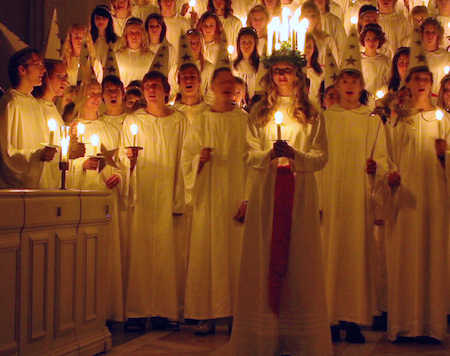
At the same time, the state churches of the region have retained some social importance. In Britain, the queen remains head of the Church of England, while Anglican bishops are peers in the House of Lords. Meanwhile, polls consistently show that levels of trust in the Lutheran Church are high in Scandinavia. Most Scandinavians are baptized, married (if they marry – over  half of births are to non-married couples), and buried by state churches. In Sweden, most families light Advent candles and St. Lucy’s Day processions remain popular.
André Malraux predicted that the 21st century would be religious, or it would not be at all. Sociologists note that, even in secularized societies, people thirst for things spiritual. Despite the aforementioned social and cultural visibility of Protestantism in Northern Europe, however, the Lutheran and Anglican Churches there are dying. British sociologists predict that practicing Anglicans will soon meet the fate of the Dodo and woolly mammoth, falling from 800,000 to just 50,000 by mid-century (Episcopalians face similar disastrous prospects in North America). In Sweden, 4 percent of Lutherans attend services regularly, while the corresponding figures in Norway and Finland are below 2 percent.
By contrast, the Catholic Church is experiencing a mini-renaissance in Northern Europe. There are currently more practicing Catholics than Anglicans in Britain. In Scandinavia, there are about 600,000 Catholics, roughly 3 percent of the region’s population (a proportion similar to that of Catholics in Asia). Certainly, part of this has to do with immigration. Since the European Union expanded to include less prosperous former East Bloc states in 2004, Scandinavia and the British Isles have been deluged by immigrants from the Catholic nations of Poland (2.2 million Poles have left their country in the past decade), Slovakia, Croatia, and Lithuania.
While Mass is celebrated in Polish or Serbo-Croatian across Northern Europe, the region’s indigenous population is also being drawn to the Catholic Church. In the past decade, the number of British seminarians has grown fourfold. This cannot be explained by immigration (young Polish immigrants who enter seminary usually go home) or by short bursts of enthusiasm, such as that after Pope Benedict XVI’s visit in 2010, as this upward tendency has been ongoing for ten years.
Currently, Scandinavia is one of the most vocations-rich regions in the Northern Hemisphere. The Church has 103,000 members in Sweden and 17 seminarians. By contrast, the Archdiocese of Vienna has thirteen times as many faithful but fewer than twice as many men studying to be priests.
 
A St. Lucy's Day celebration in Sweden
A St. Lucy’s Day celebration in Sweden
 
In 2009, the relics of St. Thérèse of Lisieux traveled across Britain, attracting the largest English pilgrimages since the Middle Ages. Young British Catholics are creating new initiatives such as the annual St. John Paul II Walk pilgrimage. The sacrament of reconciliation is making a comeback in the Isles: the number of British Catholics attending confession has mushroomed by two-thirds since 2010.
In Scandinavia, the Neocatechumenal Way – a mission-focused community founded by Spanish painter Kiko Argüello – is playing a key role in evangelization. Denmark, a country with just 40,000 Catholics, has 18 Neocatechumenal seminarians, while Finland, with just 10,500 Catholics, has 15. Meanwhile, a growing number of Scandinavians are becoming nuns; their number has inched up to 680. Cloistered orders are particularly successful in attracting new members. There is one nun for 880 Catholics in the region; in the United States, the corresponding number is one per 1,400. However, the number of American nuns is rapidly declining, while female religious are growing in Scandinavia.
Northern Europe is proving to be fertile ground for converts. In 2009, Pope Benedict XVI created the Personal Ordinariate of Our Lady of Walsingham, allowing Anglican priests to cross the Tiber. Since then, many Anglican clerics, frustrated with Canterbury’s eschewing of tradition, have done so. Scandinavian converts are hoping that the Vatican will create a similar ordinariate for Lutherans. Meanwhile, one of Scandinavia’s best-known Christian leaders – charismatic pastor Ulf Ekman – recently converted to Catholicism along with his wife. He said that the Catechism of the Catholic Church is the best book he has ever read.
Northern Europe is clearly one of the world’s most Godless regions. Yet, at the same time, the Catholic Church, while a minority denomination, is experiencing a revival that only Counterreformation popes could have dreamed of. There is an important lesson to be drawn from this.
As Christ said, His followers are to be the salt of the earth. The Lutheran and Anglican Churches have long lost their taste. Other than some fading rituals, they have become largely indistinguishable from the broader secular culture. The fact that the Lutheran bishop of Stockholm is a practicing lesbian perhaps best epitomizes what has happen to Northern European Protestantism. Catholicism has always been countercultural, and while political climates and intellectual currents have changed, it has retained its belief in one moral truth. Despite the pressures by some Catholics, the Church has remained steadfast in its proclamation of truth even while that truth has been unpopular.
Many have jokingly said that the Church of England is the Tory Party at prayer. Today, the Church of England and Lutheran churches are secularism at prayer. From teachings on life and marriage to women’s ordination, Northern European Protestant churches have made it seem that morality is something changeable. This makes such churches seem less credible. Yet spiritually hungry hearts like Ulf Ekman and the ex-Anglicans Catholic priests want something more. They want a Church more interested being coherent in its teaching than in receiving praise in the New York Times.
 
....
 
Taken from: http://thecatholicthing.org/2014/11/29/a-catholic-revival-in-northern-europe/


“Man surprised me most about humanity". Dalai Lama.

Someone Asked The Dalai Lama What Surprises Him Most, His Response Was Mind Altering


May 25, 2014 by .

You could say that the Dalai Lama is a pretty interesting guy, after all his stance on extra terrestrial life is quite interesting. During an interview the Dalai Lama was asked what surprises him the most, his response was quite mind altering.

“Man surprised me most about humanity. Because he sacrifices his health in order to make money.
Then he sacrifices money to recuperate his health. And then he is so anxious about the future that he does not enjoy the present; the result being that he does not live in the present or the future; he lives as if he is never going to die, and then dies having never really lived.”
dalai-lama

Pretty striking and powerful stuff if you really take it in. Sure, it’s easy to read this quote and move onto another page or video or whatever we may be doing, but if you truly take the time to let this reverberate in your conscious mind for a few minutes, the true meaning and profoundness of what he’s saying will kick in.
 

Everything Is Backwards On Earth!


We do so many things backwards here. We go about our lives in such a destructive manner on so many levels, only to use money to fix it. In order to get that money we have to work most of our days at jobs we for the most part don’t like -which of course is not good for your health to begin with. We do all this while thinking of all the toys we can buy with the money or saving for retirement that we may never make it to. It appears as though we live to work more than anything else here. In a sense we are like
slaves only we don’t know it.
The Dalai Lama’s quote and what it inspires within me reminds me of one of my favorite quotes that I feel sums up how we do things here in such a beautiful way.

“Just look at us. Everything is backwards, everything is upside down. Doctors destroy health, lawyers destroy justice, psychiatrists destroy minds, scientists destroy truth, major media destroys information, religions destroy spirituality and governments destroy freedom.” – Michael Ellner

....


Taken from: http://www.collective-evolution.com/2014/05/25/someone-asked-the-dalai-lama-what-surprises-him-most-his-response-was-mind-altering/